
Summary
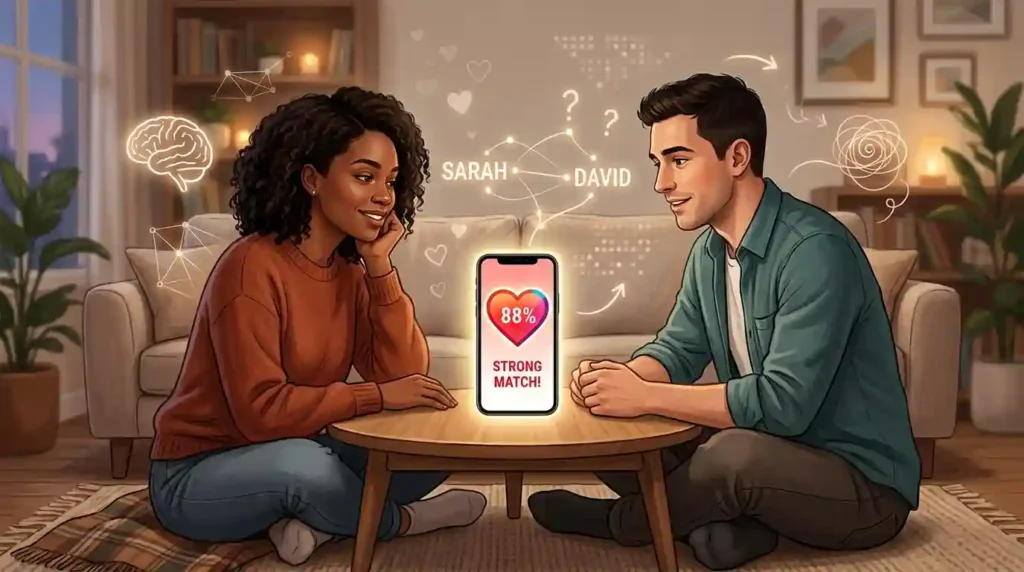
Why People Trust Love Calculator results has less to do with scientific evidence and more to do with human psychology. Love calculators offer quick answers to emotionally complex questions, create a sense of personal relevance, and turn romantic uncertainty into a simple compatibility percentage. People may accept or enjoy these results because of confirmation bias, the Barnum effect, emotional reassurance, curiosity, social influence, and the entertaining nature of the experience. Although a love calculator cannot objectively predict relationship success, it can encourage reflection and conversation when users treat the result as playful guidance rather than proof.
Table of Contents
- What a Love Calculator Actually Measures
- Why People Trust Love Calculator Results Without Proof
- The Psychology Behind Love Compatibility Scores
- How Personalization Makes Results Feel Accurate
- Why Positive Results Are Easier to Believe
- The Role of Uncertainty in Romantic Relationships
- Why People Trust Love Calculator Even When It Is for Fun
- Social Sharing, Gamification, and Online Influence
- Can a Love Calculator Reveal Anything Useful?
- When Trusting a Compatibility Score Becomes Harmful
- How to Use a Love Calculator Responsibly
- Conclusion
- FAQs
What a Love Calculator Actually Measures
A love calculator is an online entertainment tool that produces a romantic compatibility score from information such as two names, birth dates, zodiac signs, or answers to a short questionnaire. Depending on the tool, the result may appear as a percentage, compatibility level, relationship message, or romantic prediction.
The important point is that different calculators use different methods. Some compare letters in names. Others assign numerical values to characters, use numerology-inspired patterns, analyze zodiac combinations, or apply a fixed formula to user inputs. Many tools are designed primarily to create an enjoyable experience rather than conduct a psychological assessment.
A simple name-based calculator does not know how two people communicate, resolve disagreements, express affection, manage money, or respond to stress. It cannot observe emotional maturity, personal values, attachment patterns, life goals, or relationship history. These factors play a much more meaningful role in long-term compatibility.
That does not make a love calculator useless. It simply defines its proper role. The tool can provide entertainment, create a conversation starter, or encourage someone to think about a relationship. Problems arise only when a user treats an automatically generated score as objective evidence.
People who want to explore the experience can try a Love Compatibility Score checker while remembering that the percentage is designed for curiosity and reflection, not professional relationship evaluation.
Why People Trust Love Calculator Results Without Proof
People regularly trust ideas that feel personally meaningful even when those ideas are not supported by strong evidence. This is especially common when emotions are involved.
Romantic relationships create powerful questions:
- Does this person really like me?
- Are we compatible?
- Could this relationship last?
- Am I making the right emotional choice?
- Does the other person feel what I feel?
These questions rarely have immediate or perfectly certain answers. A love calculator responds within seconds. Instead of asking someone to tolerate ambiguity, it produces a clear number such as 78%, 86%, or 94%.
That number can feel like an answer, even when the user knows very little about the method behind it.
A Number Feels More Objective Than a Feeling
Numbers often create an impression of precision. A person may view “You seem compatible” as a vague opinion but interpret “Your compatibility is 87%” as a measured conclusion.
The percentage creates what might be called an appearance of objectivity. It looks calculated, structured, and specific. The result may therefore feel more credible than a general romantic statement, even when the score comes from a simple rule or randomized formula.
Specificity and accuracy, however, are not the same thing. A calculator can display a precise number without measuring anything scientifically meaningful.
Fast Answers Reduce Emotional Discomfort
Uncertainty can be uncomfortable, particularly during the early stages of attraction. People may not know whether to confess their feelings, continue pursuing a relationship, or protect themselves from disappointment.
A love compatibility result offers temporary emotional closure. A high score can create hope. A low score can give someone an explanation for hesitation. In both cases, the tool replaces an open question with a definite-looking answer.
This process is sometimes more emotionally satisfying than admitting that the future of a relationship remains unknown.
Users Participate in Creating the Meaning
The calculator usually produces a short result, but the user supplies the emotional context. A person connects the score to private memories, messages, conversations, expectations, and hopes.
For example, a result might say that two people have “strong chemistry but need honest communication.” That statement can apply to many couples. Yet a user may immediately remember a recent misunderstanding and conclude that the calculator has accurately identified the relationship.
The personal interpretation makes the result feel more intelligent than the underlying system may actually be.
The Psychology Behind Love Compatibility Scores
Several well-known psychological tendencies help explain why a love score can feel convincing.
The Barnum Effect
The Barnum effect describes the tendency to accept broad or general personality statements as uniquely accurate when they appear to be personalized. It is also commonly associated with the work of psychologist Bertram Forer and is sometimes called the Forer effect.
According to the authoritative overview of the Barnum effect from Encyclopaedia Britannica, people may believe that a general description applies specifically to them even when the same description could fit many others.
Love calculator messages often contain balanced statements such as:
- You care deeply but sometimes hide your feelings.
- Your connection is strong, although communication may need attention.
- Both partners value loyalty but can become emotionally uncertain.
- This relationship has potential if both people make an effort.
These statements sound personal because they describe common relationship experiences. Most couples experience affection, doubt, conflict, hope, and communication problems at different times.
When a statement matches one part of the user’s experience, the entire result may begin to feel accurate.
Confirmation Bias
Confirmation bias is the tendency to notice and value information that supports an existing belief while giving less attention to information that challenges it.
Someone who already believes a relationship is special may accept a high compatibility percentage immediately. The result supports what the person wants or expects to be true.
If the score is low, the same person may reject the calculator as inaccurate and try another version. After receiving a more favorable score, that result may feel more trustworthy.
This selective response is important. Users do not always trust every love calculator result. They are often more willing to trust results that agree with their existing emotions.
Emotional Reasoning
Emotional reasoning occurs when a person treats a strong feeling as evidence. Someone may think:
“I feel deeply connected to this person, so the high score must be correct.”
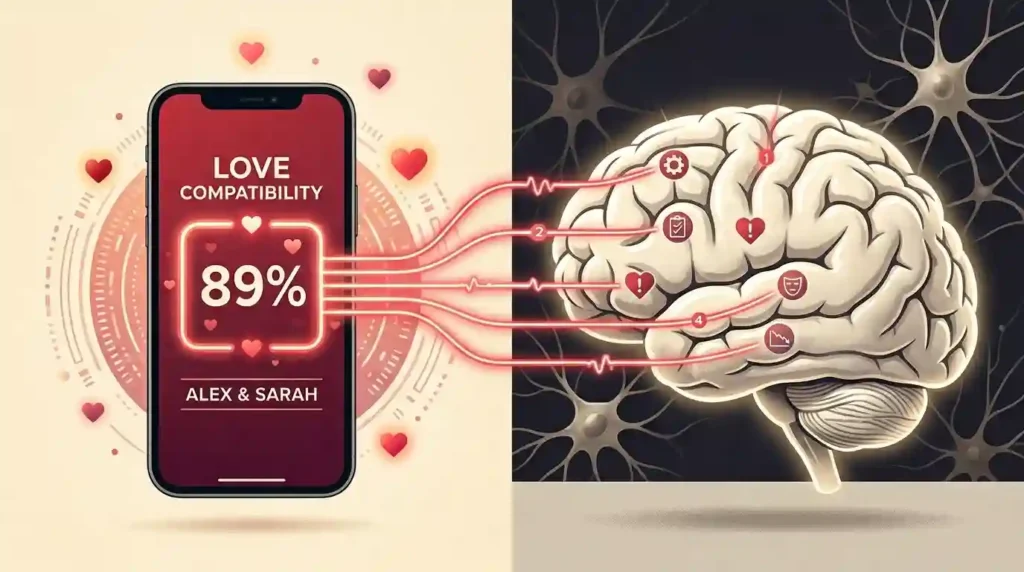
The feeling itself is real. The conclusion about the calculator does not necessarily follow from it. However, when an external result reflects an internal emotion, the agreement can feel like validation.
The Illusion of Control
Relationships involve another person’s independent thoughts, choices, and emotions. That makes complete control impossible.
Entering names into a calculator creates a small ritual in which the user takes action, receives feedback, and gains a sense of direction. The process can make an unpredictable romantic situation feel more manageable.
The calculator does not actually control the relationship, but interacting with it can reduce the feeling of helplessness.
How Personalization Makes Results Feel Accurate
Personalization is one of the strongest reasons online compatibility tools feel convincing.
A result becomes more emotionally engaging when it includes the users’ names, initials, birth dates, photographs, zodiac signs, or selected preferences. Even basic personalization can create the impression that the system has analyzed something unique.
Names Carry Emotional Importance
A name is not emotionally neutral. Seeing your name beside the name of someone you like can create an immediate personal reaction.
The calculator may be using a simple letter-counting system, but the visual presentation feels intimate. The names transform a generic score into “our result.”
This is why a name-based tool can feel meaningful even when users understand that the process is automated. The emotional importance comes from the people represented by the names, not necessarily from the mathematical method.
Readers interested in the technical and entertainment-based process can explore How Name-Based Love Calculators Generate Results.
Input Effort Increases Perceived Value
People often value a result more when they have participated in producing it. Entering information, selecting options, answering questions, and waiting for an animated calculation sequence can create a sense that meaningful analysis is happening.
A calculator that instantly displays a random percentage may feel less persuasive than one that appears to process several inputs. Progress bars, spinning heart icons, matching animations, and staged results increase anticipation.
The extra interaction does not automatically improve accuracy. It improves the experience and may increase perceived credibility.
Personalized Language Encourages Identification
A message addressed directly to the user feels more relevant than a neutral statement.
Compare these two examples:
“Some relationships require patience.”
“Your relationship can grow when both of you practice patience.”
The second sentence feels more personal, even though it does not contain specific evidence about the couple. Pronouns such as “you,” “your,” and “both of you” encourage the reader to connect the message to personal experience.
Why Positive Results Are Easier to Believe
Most people use a love calculator because they are curious, hopeful, attracted to someone, or already emotionally invested. In that context, a positive score provides a small emotional reward.
Positive Feedback Creates Reassurance
A high percentage can provide reassurance without requiring a difficult conversation. It may briefly reduce fears of rejection, incompatibility, or romantic failure.
This reassurance can be especially appealing when someone is waiting for a message, thinking about a new crush, or questioning an existing relationship.
Flattering Results Feel Personally True
Positive descriptions are often easier to accept than harsh ones. A message describing someone as loyal, caring, passionate, or emotionally deep may feel accurate because it supports a positive self-image.
When the result also describes the potential partner positively, the tool creates a hopeful story about the relationship. The user may remember the flattering statements more clearly than the generic or negative ones.
Hope Changes the Standard of Evidence
People usually demand less evidence for conclusions they want to believe. A favorable score may be accepted as a sign, while an unfavorable result is dismissed as entertainment.
This does not mean users are unintelligent. It reflects a common human tendency to evaluate information through emotional goals as well as logic.
The Role of Uncertainty in Romantic Relationships
Romantic uncertainty is one of the strongest forces behind the popularity of compatibility tests.
People want to know how another person feels, but direct communication can be risky. Asking someone about commitment, attraction, or long-term intentions creates the possibility of rejection.
A love calculator offers an emotionally safer alternative. It lets someone explore the possibility of a relationship without exposing their feelings to the other person.
The Tool Creates a Temporary Story
Human beings naturally organize uncertain experiences into stories. A compatibility result gives the relationship a simple narrative:
- The connection is strong.
- The attraction exists, but communication needs work.
- The couple is different but complementary.
- The relationship has long-term potential.
- Both partners must become more emotionally open.
A coherent story can feel comforting because it gives scattered emotions a recognizable structure.
The Result Functions as a Conversation Starter
Some users do not literally believe the score. They use it to begin a playful conversation.
Sending a result to a crush can communicate interest indirectly. Asking, “How did we get 92%?” may feel safer than saying, “I am interested in you.”
Couples may also compare scores for fun, discuss whether the description fits, or use the result as an opportunity to talk about affection and expectations.
In this context, the practical value of the tool comes from the conversation it creates, not the predictive power of the percentage.
Why People Trust Love Calculator Even When It Is for Fun
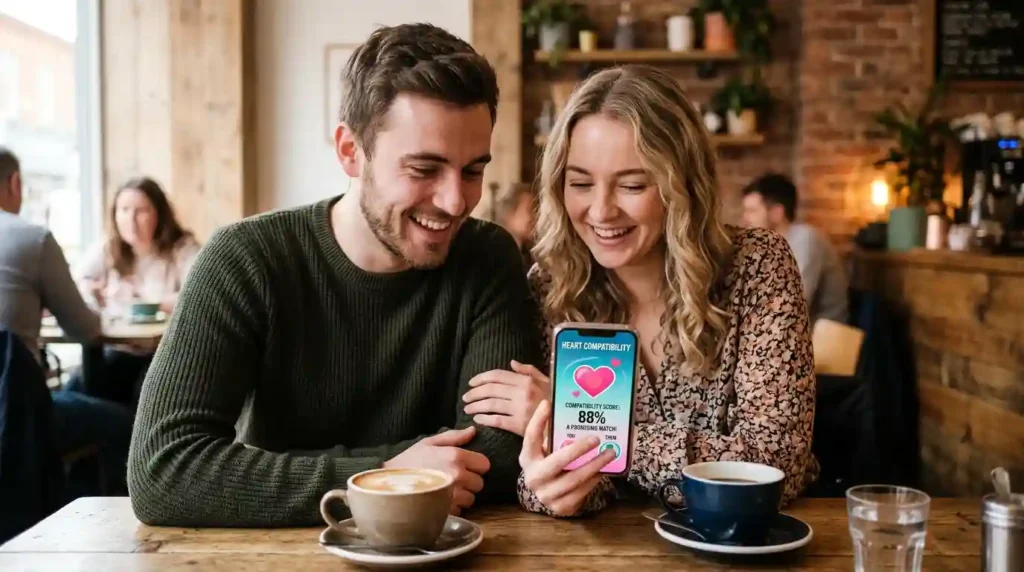
Trust is not always absolute. A user can understand that a love calculator is entertainment while still feeling emotionally affected by the result.
People frequently participate in rituals, quizzes, games, and personality tests without fully believing in their scientific accuracy. The experience can still produce genuine excitement, disappointment, curiosity, or reflection.
Playfulness Lowers Critical Resistance
When something is presented as fun, people are less likely to analyze every assumption behind it. They temporarily suspend disbelief and participate in the experience.
This is similar to watching a fictional romance. Viewers know the story is invented, but they can still feel emotionally involved.
A love calculator benefits from the same mental flexibility. Users may not claim that the percentage is scientifically valid, but they allow the result to feel meaningful for a moment.
Repetition Creates Familiarity
Love calculators have existed in different forms for years. They appear on entertainment websites, mobile applications, social media posts, school notebooks, magazines, and relationship quizzes.
Repeated exposure makes the concept familiar. Familiar ideas often feel safer and more credible than completely unfamiliar ones, even when familiarity does not provide evidence.
People Can Hold Two Interpretations at Once
A user may think:
“This is only a game, but the result is surprisingly accurate.”
These thoughts are not necessarily experienced as contradictory. The person can classify the tool as entertainment while treating certain parts of the result as personally relevant.
This flexible interpretation allows the calculator to remain enjoyable whether the score is high, low, or unexpected.
Social Sharing, Gamification, and Online Influence
Modern love calculators are designed to be interactive and shareable. Their popularity is strengthened by the way people use digital platforms.
Social Proof Encourages Participation
When users see friends posting compatibility scores, they may try the same tool. The number of shares, reactions, comments, or testimonials can create the impression that the calculator is worth using.
Social popularity does not prove accuracy, but it reduces hesitation. A person may think that a widely shared tool must be interesting, credible, or at least entertaining.
Gamification Makes the Result Memorable
Many calculators use features associated with games:
- Percentage meters
- Animated hearts
- Progress bars
- Compatibility levels
- Share buttons
- Color-coded scores
- Dramatic result messages
- Options to calculate again
These elements create anticipation and reward. The user is not simply reading information. The user is completing a small emotional game.
A dramatic reveal can make an otherwise arbitrary number feel important.
Sharing a Result Reinforces It
Once someone sends or posts a score, the result becomes part of a social interaction. Friends may comment, tease, celebrate, or question it.
That discussion gives the score a longer life. The result may begin as a private curiosity but become more meaningful because other people respond to it.

Can a Love Calculator Reveal Anything Useful?
A basic name-based love calculator cannot scientifically measure the quality or future of a relationship. However, the experience can still reveal something about the user’s own reaction.
Imagine receiving a very high score. Do you feel relieved, excited, skeptical, or pressured?
Now imagine receiving a very low score. Do you feel disappointed, defensive, amused, or tempted to try again?
Those reactions may reveal expectations that existed before the calculation. The score does not uncover the truth about the relationship, but the emotional response may help someone recognize personal hopes and fears.
Useful Reflection Questions
Instead of asking whether the score is correct, users can ask:
- Why did I want a high result?
- Would a low score change how I treat this person?
- What real experiences make me believe we are compatible?
- Can we communicate honestly?
- Do our values and future goals align?
- Do I feel respected and emotionally safe?
- How do we handle conflict or disappointment?
- Am I relying on a tool because I am afraid to have a direct conversation?
These questions produce more meaningful information than a percentage alone.
Evidence-Based Compatibility Is More Complex
Healthy relationship compatibility is not a single fixed trait. It can involve emotional safety, communication, trust, shared values, mutual attraction, respect, boundaries, lifestyle preferences, conflict management, and willingness to grow.
Two people can share many interests and still struggle with honesty or emotional regulation. Another couple may have different hobbies but communicate well and respect each other’s needs.
No single automated score can capture all these dimensions.
When Trusting a Compatibility Score Becomes Harmful
Using a love calculator for entertainment is generally different from allowing it to control serious personal decisions.
Trust becomes unhealthy when someone:
- Ends a stable relationship solely because of a low score
- Ignores disrespect or manipulation because of a high score
- Repeatedly calculates results to manage anxiety
- Uses the score to pressure another person
- Treats compatibility as fate rather than shared effort
- Avoids necessary communication
- Uses a result as proof that another person must return their feelings
A compatibility percentage cannot override consent, boundaries, behavior, or personal judgment.
A High Score Does Not Excuse Harmful Behavior
Someone may feel tempted to interpret a high result as evidence that a difficult relationship is “meant to be.” That interpretation can become dangerous when it causes the person to excuse controlling, dishonest, or abusive behavior.
Real compatibility should never require someone to abandon safety, dignity, or personal boundaries.
A Low Score Does Not Define a Relationship
A low percentage does not prove that two people are wrong for each other. It may simply reflect an arbitrary formula, limited inputs, or a deliberately unpredictable entertainment system.
The quality of a relationship should be assessed through real interactions and patterns over time.
How to Use a Love Calculator Responsibly
A love calculator is most useful when approached with curiosity and perspective.
Treat the Result as Entertainment
Enjoy the percentage, read the description, and share it with someone when appropriate. Do not treat it as a diagnosis, prediction, or instruction.
Compare the Message With Real Evidence
Ask whether the relationship demonstrates trust, respect, communication, and mutual interest. Real behavior should carry more weight than an automated result.
Use the Score to Begin a Conversation
A playful result can lead to meaningful questions:
- What makes us feel compatible?
- Where are we different?
- How do we show affection?
- What helps us resolve disagreements?
- What do we expect from this relationship?
The discussion may be useful even when the score itself is not.
Respect the Other Person’s Perspective
A love calculator cannot determine another person’s feelings. A high score does not create romantic interest or commitment.
Relationships require mutual agreement. A calculator result should never be used to pressure someone into emotional or romantic involvement.
Recognize When You Are Seeking Reassurance
Repeatedly checking compatibility scores may be a sign that the real issue is anxiety or uncertainty. At that point, direct communication, personal reflection, or support from a qualified professional may be more helpful than another calculation.
Conclusion
People trust love calculators because the tools respond to emotional needs that scientific evidence alone does not address. They provide immediate answers, personalized feedback, reassurance, entertainment, and a temporary sense of control over romantic uncertainty.
Psychological tendencies such as confirmation bias, emotional reasoning, the Barnum effect, familiarity, and selective attention can make general results feel surprisingly accurate. Personal names, percentage scores, animations, and positive relationship messages strengthen that impression.
The appeal of a love calculator is therefore understandable. People are not merely trusting a number. They are responding to the hope, fear, curiosity, and personal meaning surrounding the relationship.
A love compatibility score can be enjoyable and may even inspire useful reflection. It should not, however, replace communication, observation, mutual consent, emotional safety, or thoughtful decision-making. The healthiest approach is to enjoy the result as a playful prompt while judging the relationship through real behavior and shared experience.
FAQs
Why do love calculator results feel so accurate?
They often use broad relationship statements that can apply to many people. Personal names, direct language, and percentage scores encourage users to connect those statements to their own experiences. Confirmation bias and the Barnum effect can make matching details feel more important than inaccurate ones.
Are love calculators scientifically proven?
Most entertainment-based love calculators are not scientifically validated relationship assessments. They generally use names, dates, letter patterns, numerology-inspired systems, fixed formulas, or randomized elements. They cannot measure the full complexity of a relationship.
Can names determine romantic compatibility?
Names alone cannot reliably determine emotional or long-term compatibility. A person’s name does not reveal communication skills, values, emotional maturity, boundaries, attachment patterns, or relationship behavior.
Why do people believe a high love compatibility score?
A high score may confirm existing attraction or hope. Positive feedback also provides reassurance and emotional reward, making it easier to accept than an unwanted or disappointing result.
Why do people reject low compatibility results?
A low result may conflict with the user’s existing feelings. The person may dismiss the tool, question its formula, or try another calculator until receiving a result that better matches personal expectations.
Is it harmful to use a love calculator?
Using one for fun is not usually harmful. It becomes problematic when someone relies on the score for serious relationship decisions, ignores real warning signs, pressures another person, or repeatedly checks scores to manage anxiety.
Can a love calculator predict marriage success?
A basic online calculator cannot reliably predict whether a marriage will succeed. Long-term relationships depend on factors such as trust, communication, respect, conflict resolution, shared values, commitment, and changing life circumstances.
Can love calculators help couples communicate?
They can serve as lighthearted conversation starters. Couples may use the result to discuss their similarities, differences, expectations, and communication styles. The value comes from the conversation rather than the percentage.
What should I trust instead of a love calculator score?
Pay attention to consistent behavior, honesty, emotional safety, mutual effort, compatible goals, respect for boundaries, and the way both partners handle disagreements. These provide more useful information than an automated score.
Why are love calculators still popular?
They are quick, free, personal, shareable, and emotionally engaging. They combine romantic curiosity with the reward structure of an online game, making them appealing even to users who know the results are not scientific.