
Summary
Have you ever typed two names into a love calculator and wondered what’s actually happening behind the scenes? How name-based love calculators generate results is a question that blends ancient numerology, string-processing algorithms, and modern entertainment psychology. These tools take the letters in your name and your partner’s name, convert them through mathematical formulas, and spit out a compatibility percentage that feels surprisingly believable. While they’re primarily designed for fun, understanding the mechanics behind them reveals a fascinating mix of number theory, cultural symbolism, and clever coding logic. In this guide, we’ll break down every layer — from letter-to-number mapping to the final percentage display — so you know exactly what’s powering that love score.
Table of Contents
- What Are Name-Based Love Calculators?
- How Name-Based Love Calculators Generate Results — The Core Mechanics
- The Role of Numerology in Love Compatibility Tools
- String Algorithms and Character Mapping Explained
- How Name-Based Love Calculators Generate Results Using Vowel-Consonant Analysis
- The Psychology Behind Why We Trust the Output
- Are the Results Random or Formula-Driven?
- How Modern Love Calculators Differ from Classic Versions
- The FLAMES Game Method and Its Digital Evolution
- Conclusion
- FAQs
1. What Are Name-Based Love Calculators?
Name-based love calculators are digital tools — found on websites and mobile apps — that accept two names as input and return a romantic compatibility percentage or score. They’re one of the most searched entertainment tools online, drawing millions of users monthly who are curious about their relationship potential.
Unlike psychological compatibility tests (such as the Myers-Briggs pairing or the Big Five personality model), name-based calculators don’t ask you questions about behavior, values, or communication style. Instead, they rely entirely on the character sequences found within your names.
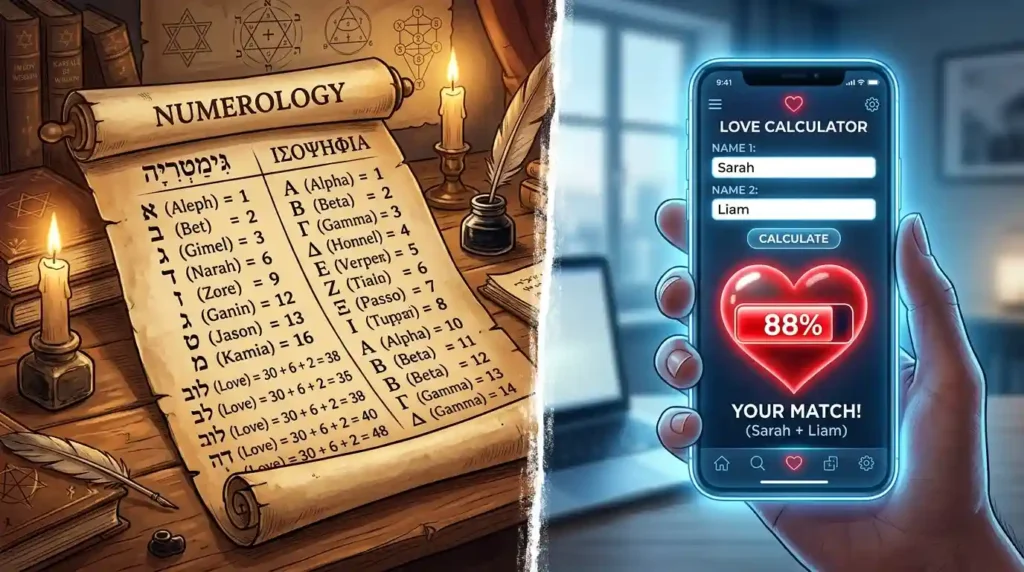
This approach traces its roots to numerology — the ancient metaphysical discipline that assigns numeric values and meanings to letters and numbers. Cultures from ancient Greece to the Vedic tradition in India have long believed that names carry vibrational energy and that comparing those energies reveals hidden truths about relationships.
Today’s digital love calculators take those traditional frameworks and encode them into JavaScript functions, PHP scripts, or Python algorithms that produce an instant result in milliseconds.
2. How Name-Based Love Calculators Generate Results — The Core Mechanics
The most fundamental question is: what’s actually happening when you hit “Calculate”?
At the most basic level, a name-based love calculator follows these core steps:
Step 1 — Input Cleaning
The tool strips spaces, converts both names to the same case (usually lowercase or uppercase), and removes special characters. This normalization ensures the algorithm processes clean data.
Step 2 — Character-to-Number Mapping
Each letter in both names is converted to a numeric value. The most common method is the simple alphabetical sequence (A=1, B=2, C=3 … Z=26). Some calculators use the Pythagorean numerology chart, which maps letters to single digits 1–9 in a repeating cycle.
Step 3 — Summation and Reduction
The numeric values of all letters are summed. In numerology-inspired tools, these sums are then reduced to single digits through repeated addition (e.g., 87 → 8+7 = 15 → 1+5 = 6). This process is called digit reduction or finding the life path number.
Step 4 — Compatibility Formula
Both names produce a reduced number. The calculator applies a compatibility formula — often a modular arithmetic operation — to compare the two numbers. The output is scaled to a percentage between 0% and 100%.
Step 5 — Display and Categorization
The percentage is displayed with a romantic label: “Perfect Match,” “Good Compatibility,” “Needs Work,” etc. These labels use sentiment thresholds (e.g., 80%+ = Perfect, 50–79% = Good, below 50% = Challenging).
This entire pipeline takes fractions of a second and is what most users experience as a magical, instantaneous love score.
If you want to try it yourself right now, use this Love Calculator Tool to see your own compatibility percentage generated in real time.
3. The Role of Numerology in Love Compatibility Tools
Numerology is the backbone of most name-based love calculators. It’s defined as the study of the mystical relationship between numbers and living things, and it has been practiced for over 2,500 years.
Within numerology, every letter of the alphabet carries a vibrational frequency expressed as a number. When you combine those frequencies — as you do when you write your name — you create a unique numeric signature called your Expression Number or Destiny Number.
The two most common numerology systems used in love calculators are:
Pythagorean Numerology
Letters are assigned values 1–9:
- A, J, S = 1
- B, K, T = 2
- C, L, U = 3
- D, M, V = 4
- E, N, W = 5
- F, O, X = 6
- G, P, Y = 7
- H, Q, Z = 8
- I, R = 9
Chaldean Numerology
A more ancient system where letters are assigned values 1–8 (the number 9 is considered sacred and is excluded from letter assignments). This system is considered more spiritually accurate by traditional numerologists.
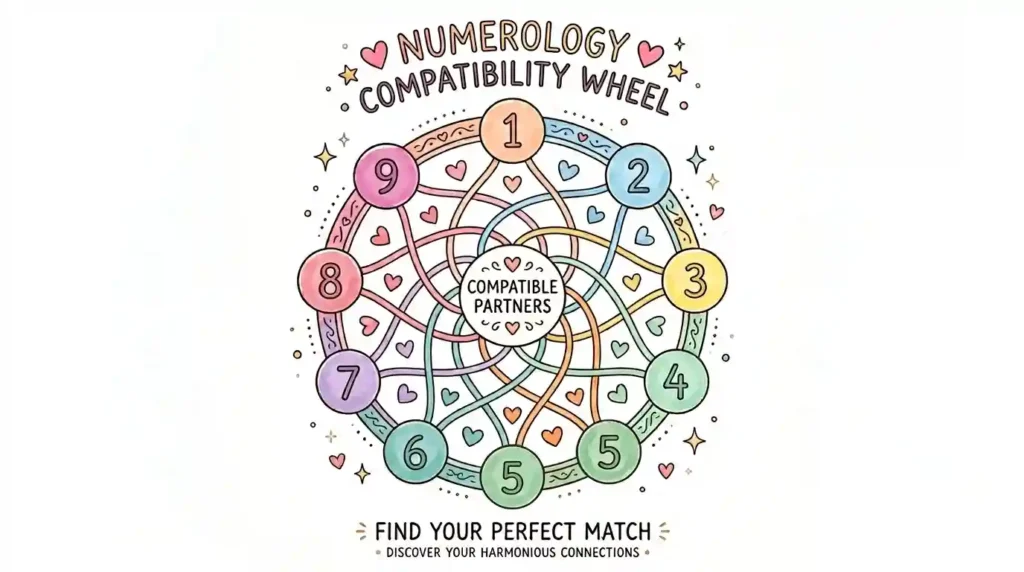
Love calculators built on numerology principles compare the core numbers of two names and check whether they fall into harmonious or conflicting numeric pairs. For example, Life Path 2 (the partnership number) is considered highly compatible with Life Path 6 (the nurturer), while Life Path 1 (the leader) may clash with another Life Path 1.
For deeper reading on numerological compatibility frameworks, the work published by Numerology.com offers an authoritative breakdown of how numbers interact in romantic relationships.
4. String Algorithms and Character Mapping Explained
Beyond numerology, many modern love calculators use string-processing algorithms — a computer science approach that treats names as sequences of characters and applies mathematical operations on them.
Here are the most commonly used algorithmic techniques:
ASCII Value Summation
Every character has an ASCII (American Standard Code for Information Interchange) value. The letter ‘A’ = 65, ‘B’ = 66, and so on. A calculator can sum all ASCII values in Name 1, sum all ASCII values in Name 2, combine them, and apply a modulus operation:
(Sum1 + Sum2) % 100 gives a result between 0 and 99, which can be presented as a percentage.
Hash-Based Mapping
More sophisticated tools use a hash function — a mathematical process that converts an input string into a fixed-size numeric value. By hashing both names and comparing their hash outputs, the calculator can generate a seemingly unique but deterministic score for any name pair.
Bitwise Operations
Some calculators XOR the numeric representations of the two names. XOR (exclusive OR) is a bitwise operator that compares two binary sequences and returns a result based on their differences. This produces scores that are highly sensitive to individual letter changes.
The beauty of algorithm-based approaches is determinism: the same two names will always produce the same result, which adds to the feeling of authenticity. If you type “Alice + Bob” today and again next week, you’ll get the same percentage — reinforcing the illusion that it’s a real, stable measurement.
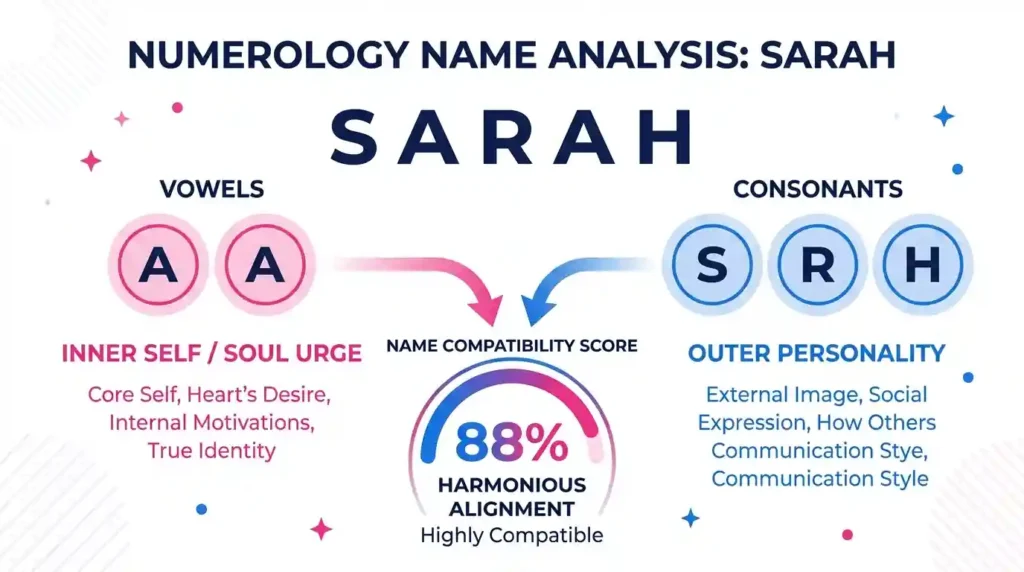
5. How Name-Based Love Calculators Generate Results Using Vowel-Consonant Analysis
One of the more nuanced methods some advanced calculators use is vowel-consonant analysis, which draws on both numerology and linguistic theory.
In this method:
Vowels (A, E, I, O, U) represent the inner self — emotional energy, desires, and feelings. In numerology, this is called the Soul Urge Number or Heart’s Desire Number.
Consonants represent the outer personality — how you appear to the world. This is known as the Personality Number.
A love calculator using this method:
- Separates vowels and consonants from both names
- Calculates Soul Urge Numbers for both people
- Calculates Personality Numbers for both people
- Runs two compatibility checks: inner compatibility (emotional match) and outer compatibility (social match)
- Averages or weights these two scores to produce a final percentage
This produces a two-dimensional compatibility score that feels more nuanced and personal than a simple letter-sum approach, which is part of why users find it more convincing and emotionally engaging.
6. The Psychology Behind Why We Trust the Output
Even when people consciously know that a love calculator is “just for fun,” many still feel a real emotional reaction to the result — happiness if the score is high, mild anxiety if it’s low. Why?
Confirmation Bias plays a huge role. If the calculator shows 92% compatibility for a couple already in a happy relationship, they notice and share it. If it shows 34%, they might dismiss it as inaccurate. This selective recall reinforces trust in the tool.
The Barnum Effect (also called the Forer Effect) is a well-documented psychological phenomenon where people rate vague, general statements as highly personally accurate. Love calculators exploit this by using broad compatibility labels (“You have strong emotional energy together”) that apply to almost any couple.
Gamification and Novelty — the act of typing names and pressing a button triggers a small dopamine release. The anticipation of the result, followed by a colorful percentage reveal, mimics the reward loop of games and lotteries.
Social Sharing Incentive — calculators are designed to be shareable. Getting a high score feels like winning, and people love sharing wins on social media, which drives more traffic back to the tool.
Understanding this psychology helps explain why love calculators have remained popular for decades despite having no scientific basis for predicting actual romantic compatibility.
7. Are the Results Random or Formula-Driven?
This is one of the most common questions users ask, and the honest answer is: it depends on the tool.
Deterministic (Formula-Driven) Calculators — The majority of reputable love calculators use a fixed algorithm. Your names always produce the same score. The formula is baked into the code, and there’s no randomness involved. These tools feel more trustworthy because consistency implies accuracy.
Pseudo-Random Calculators — Some simpler or poorly built tools use a random number generator seeded with the names. While the same names might produce the same result within a session (due to seed values), the underlying output is statistically arbitrary.
Hybrid Models — Sophisticated modern calculators sometimes blend deterministic numerology scores with randomized “flavor text” for the compatibility description, giving you a fixed percentage but a rotating set of personalized-sounding descriptions.
If you’ve ever received a surprising or confusing result, like a 0% compatibility score, it’s worth understanding what that actually means algorithmically. Read more about What Happens When Love Calculator Shows 0% Compatibility? for a detailed breakdown of that edge case.
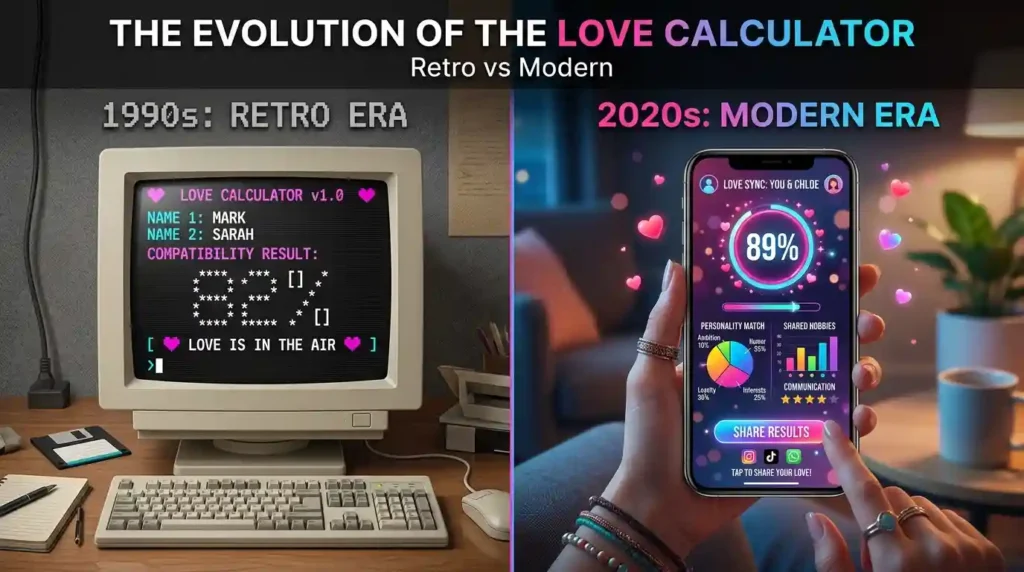
8. How Modern Love Calculators Differ from Classic Versions
The original name-based love calculator, popularized in the 1990s and early 2000s as a Flash or Java applet, was extremely simple — usually just an ASCII sum modulus formula.
Today’s calculators have evolved significantly:
Classic Calculators (1990s–2000s):
- Single algorithm (usually ASCII sum)
- No explanation of results
- Basic percentage display
- Desktop-only
Modern Calculators (2010s–Present):
- Multiple layered algorithms (numerology + character mapping + vowel analysis)
- Detailed result breakdowns with personality insights
- Mobile-responsive, fast-loading
- Social media sharing integrations
- Animated result reveals for engagement
- Multilingual support and international name handling
- AI-enhanced result descriptions
The shift toward AI-enhanced descriptions is the newest trend. Some platforms now pass the name data and compatibility score into a language model that generates a unique, personalized-sounding compatibility report — blurring the line between entertainment and pseudo-psychological profiling.
9. The FLAMES Game Method and Its Digital Evolution
No discussion of name-based love calculators is complete without mentioning FLAMES — one of the oldest and most beloved name-based compatibility games.
FLAMES stands for: Friends, Lovers, Affectionate, Marriage, Enemies, Siblings
The traditional FLAMES method:
- Write both names
- Cancel out common letters between the names
- Count the remaining letters
- Use that count to eliminate letters from F-L-A-M-E-S sequentially
- The last remaining letter reveals the relationship category
This playground game has been digitized into hundreds of online tools and apps. Modern FLAMES calculators automate the letter-cancellation process and sometimes layer it with a percentage system — adding a “love score” alongside the FLAMES category result.
The FLAMES method is interesting because it uses set theory at its core — the intersection of two character sets — which gives it a slightly more mathematically interesting foundation than simple summation methods.
10. Conclusion
Understanding how name-based love calculators generate results reveals a surprisingly rich blend of ancient numerological wisdom, computer science algorithms, linguistic analysis, and behavioral psychology. These tools convert the letters of your name into numeric values, run them through compatibility formulas, and produce a percentage that feels personal and meaningful — even though the science of romantic compatibility is far more complex than any letter-counting algorithm can capture.
That said, their value isn’t in accuracy — it’s in connection, conversation, and fun. They give couples and crushes a lighthearted reason to interact, share, and laugh together. And sometimes, that emotional moment of checking your compatibility score and squealing over the result is its own kind of love language.
Whether you’re a curious technologist, a numerology enthusiast, or just someone who wants to have fun with a partner’s name, try the Love Calculator Tool and see what your names reveal.
FAQs
Q1. Do name-based love calculators use real science?
No, name-based love calculators are not scientifically validated tools for measuring romantic compatibility. They are entertainment tools based on numerology and character-mapping algorithms. Genuine relationship compatibility involves factors like values, communication, emotional intelligence, and attachment styles — none of which can be captured by name letters alone.
Q2. Why do I always get the same result for the same two names?
Most reputable love calculators use deterministic algorithms — meaning the same input always produces the same output. The formula doesn’t change, so two names will always generate the same percentage. This consistency is by design, as it makes the tool feel more credible and trustworthy.
Q3. What numerology system do most love calculators use?
The majority of digital love calculators use the Pythagorean numerology system, which maps letters to numbers 1–9. Some more traditional or spiritually-focused tools use the Chaldean system, which maps letters to numbers 1–8 and is considered more ancient and mystically significant.
Q4. Can the calculator give a 0% compatibility result?
Yes, depending on the algorithm, certain name combinations can produce a 0% score. This happens when the numeric values of the two names, after processing through the formula, resolve to zero compatibility. It doesn’t mean the relationship is doomed — it’s simply an algorithmic edge case. Read more in our article on What Happens When Love Calculator Shows 0% Compatibility?
Q5. Is there a difference between a love calculator and a soulmate test?
Both are entertainment tools, but soulmate tests typically ask behavioral or personality questions alongside name input, producing a more complex result. Love calculators rely purely on name character analysis. Neither is a clinically validated compatibility assessment.
Q6. What does a 100% love calculator result mean?
A 100% result means the two names, when processed through the calculator’s specific algorithm, produced the maximum possible score. It does not literally mean the couple is perfect for each other — it’s the mathematical ceiling of the formula. Some algorithms are designed so that certain name structures (like names with many shared vowels or complementary numerology totals) naturally score very high.
Q7. Are love calculator results the same across different websites?
No. Each website uses its own proprietary algorithm, so the same two names can produce different percentages on different platforms. This is because each tool uses different formulas — some use ASCII sums, others use Pythagorean numerology, and others use custom hybrid methods.