
Summary
If you want to learn how to do the true love test on paper, write both people’s names, count or cancel matching letters, place the remaining counts into the chosen method, and reduce the resulting numbers until you get a final percentage. This article explains the popular TRUE LOVE letter-counting method step by step, complete with an example you can repeat using your name and your crush’s name. You will also learn alternative paper games, including LOVES and FLAMES, what the resulting compatibility score means, and why these tests should be enjoyed as entertainment rather than treated as scientific relationship advice.
Table of Contents
- What is a true love test on paper?
- What you need before starting
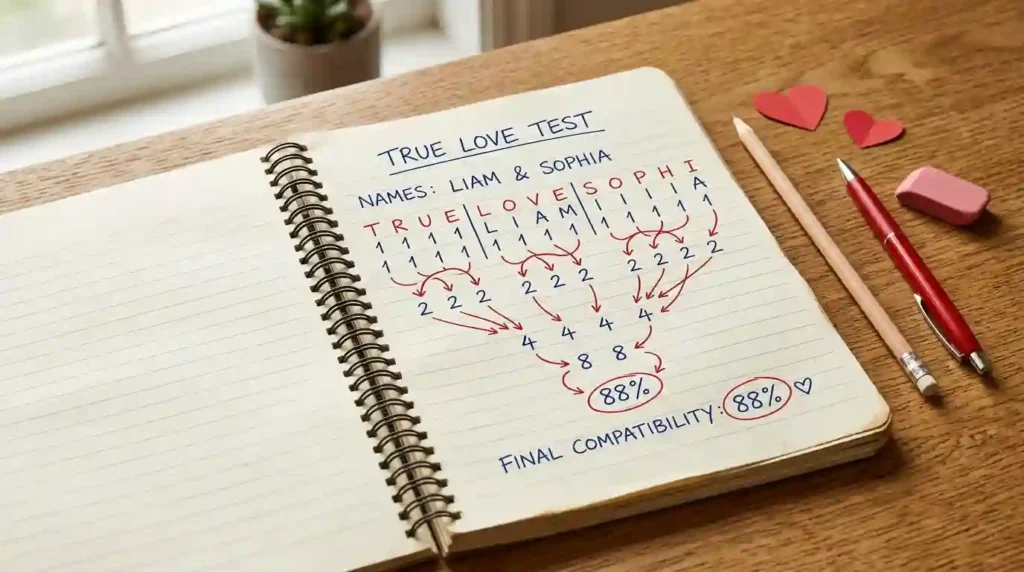
- How to do the true love test on paper
- A complete TRUE LOVE calculation example
- How to calculate the final percentage
- Alternative love tests you can play on paper
- Common mistakes that change the answer
- Can names really measure relationship compatibility?
- How to interpret your love percentage
- Frequently asked questions
What Is a True Love Test on Paper?
A true love test on paper is a playful name compatibility activity in which two names are converted into letters and numbers. Those numbers are then processed using a fixed formula to produce a love percentage or relationship category.
Unlike an online Love Calculator by Name, a paper love test lets you see and perform every part of the calculation yourself. All you need is a pen or pencil, a piece of paper, and two names.
Several versions of the game exist. Some people count the letters in the phrase “TRUE LOVE,” while others cancel matching letters from two combined names. Popular variations include:
- The TRUE LOVE method
- The LOVES method
- The FLAMES game
- A common-letter cancellation method
- Adjacent-digit addition
- Name numerology using a date of birth
The results can differ because these methods use different rules. For example, one method may use full names while another uses only first names. Some versions count every repeated letter, whereas others count only common letters.
Despite these differences, each version has the same purpose: turning two names into a fun compatibility score.
What You Need for a Paper Love Test
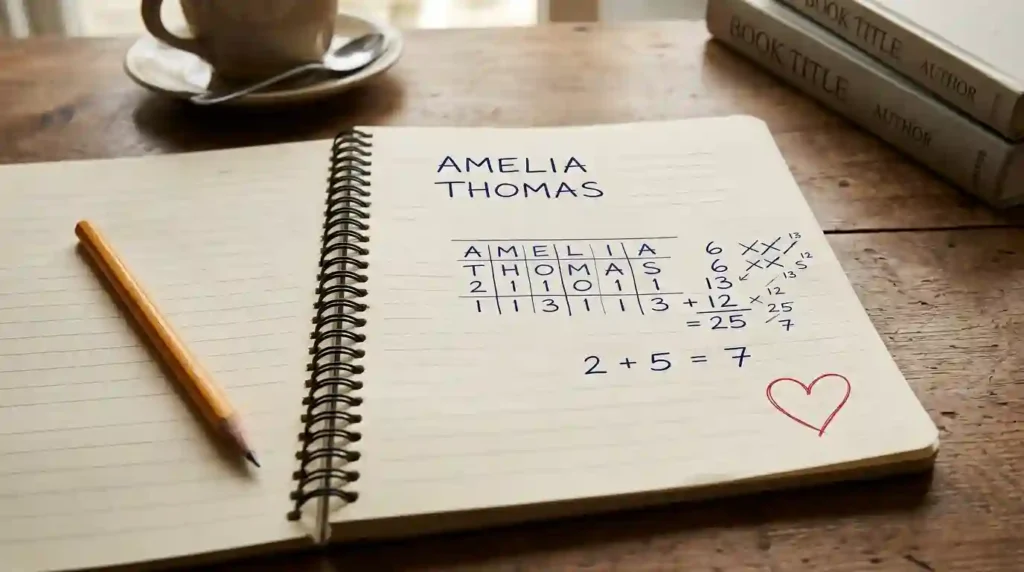
The paper version requires no special equipment. Prepare:
- One clean sheet of paper or a notebook
- A pen or pencil
- Your first name or full name
- Your crush’s name or partner’s name
- A calculator only if you want to check your arithmetic
Before beginning, decide which form of the names you will use. If you write your full name, use the other person’s full name as well. If you choose first names, use first names for both people.
Consistency matters because name spelling affects letter frequency and letter counts. For example, “Sara” and “Sarah” do not contain the same number of letters. Likewise, using a nickname for one person and a legal name for the other can produce a different score.
Write both names in lowercase letters and remove spaces, punctuation, numbers, hyphens, and other non-letter characters. This gives you a clean, reproducible starting point.
For example:
- “Emma Rose” becomes
emmarose - “Noah-James” becomes
noahjames - “Ava123” becomes
ava
If you follow the same spelling and the same rules each time, the method produces a deterministic result. In other words, repeating the calculation with identical inputs should generate the same score.
How to Do the True Love Test on Paper
The following TRUE LOVE method is one of the easiest paper-based calculations to understand and repeat.
Step 1: Write Both Names
Write your name and the other person’s name on the first line.
For this example, we will use:
Emma + Liam
You can use a crush’s name, partner’s name, or even two fictional names when learning the method.
Step 2: Combine and Standardize the Names
Join the two names and convert them to lowercase:
emmaliam
Remove spaces and non-letter characters. Do not remove repeated letters because every occurrence contributes to the letter-counting method.
Step 3: Write “TRUELOVE” Below the Names
On the next line, write:
T R U E L O V E
This creates the TRUELOVE scoring column. Each letter will receive a number based on its total frequency in the combined names and the phrase “TRUE LOVE.”
Some players count letters only in the names. However, the traditional version commonly shared as a pen-and-paper game counts each target letter in the combined text:
Both names + TRUE LOVE
The important rule is to select one formula and use it consistently.
Step 4: Count Every Target Letter
Create the combined text:
EMMA LIAM TRUE LOVE
Now count how many times each letter in TRUELOVE appears.
Because “E” occurs twice in the phrase TRUELOVE, you will write its same total whenever its position appears in the scoring row.
For Emma and Liam:
| TRUELOVE letter | Count in “EMMA LIAM TRUE LOVE” |
|---|---|
| T | 1 |
| R | 1 |
| U | 1 |
| E | 3 |
| L | 2 |
| O | 1 |
| V | 1 |
| E | 3 |
The starting number is therefore:
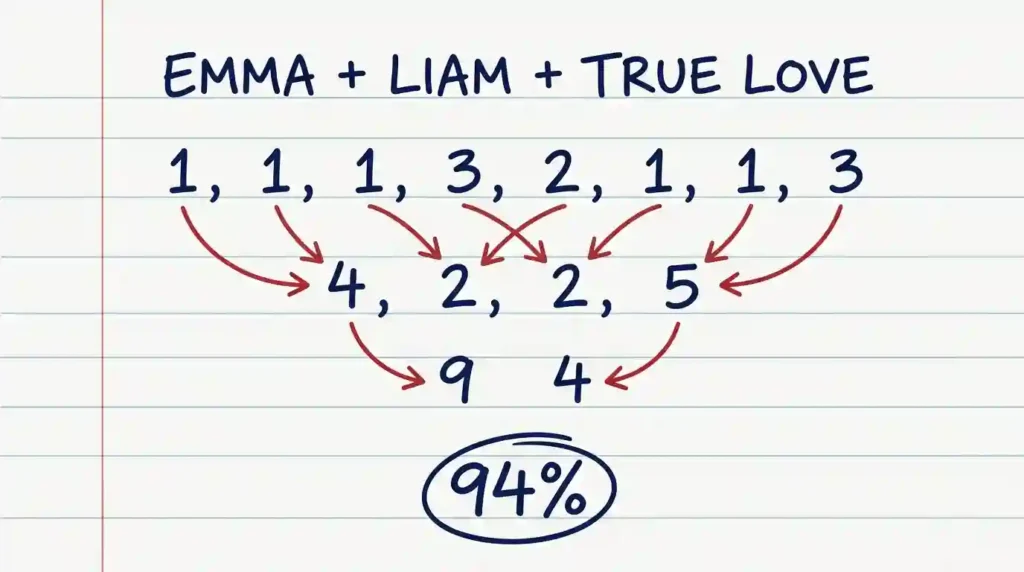
1 1 1 3 2 1 1 3
This is the TRUELOVE scoring column converted into a number row.
Step 5: Add Numbers from the Outside In
To reduce the row, add the first and last numbers, then the second and second-last numbers, continuing toward the middle.
Starting row:
1 1 1 3 2 1 1 3
Sequential pairing gives:
- 1 + 3 = 4
- 1 + 1 = 2
- 1 + 1 = 2
- 3 + 2 = 5
New row:
4 2 2 5
Repeat the same adjacent-digit addition from the outside inward:
- 4 + 5 = 9
- 2 + 2 = 4
New row:
9 4
Step 6: Read the Final Percentage
The remaining two-digit number is 94. Therefore, the final percentage for Emma and Liam is:
94%
If number reduction produces more than two digits, repeat the sequential pairing until only two digits remain. Depending on the chosen variation, a total of 100 may be treated as 100%, while results greater than 100 are usually reduced again.
This is the basic answer for anyone wondering how love percentage is calculated with a handwritten TRUE LOVE formula.
How to Do the True Love Test on Paper Using Letter Cancellation
Another familiar version uses matching letters and letter cancellation instead of a TRUELOVE scoring column.
Step 1: Write the Two Names on Separate Lines
For example:
olivialiam
Keep the names in lowercase letters so matching them is easier.
Step 2: Cancel Common Letters
Look for a letter that appears in both names. Cross out one occurrence from each name.
In this example:
- Both names contain l
- Both names contain i
- Both names contain a
Cancel one matching letter from each name. If a letter occurs twice in one name but once in the other, cancel only one pair. Each letter can be used only once.
Step 3: Count the Remaining Letters
After cancelling the common letters, count all uncancelled characters.
With Olivia and Liam:
- Olivia has three remaining letters
- Liam has one remaining letter
- Total remaining letters = 4
This number becomes the input for the next stage. You can use it in the FLAMES game, a predefined percentage table, or another fixed formula.
Step 4: Use a Consistent Scoring Rule
A cancellation count alone does not automatically create a meaningful love percentage. You need a defined rule that converts the remaining total into either:
- A percentage
- A relationship category
- A position in the word LOVES
- A position in the word FLAMES
This is why two paper methods may produce different answers for the same people. Their starting inputs and formulas are not identical.
For a more focused tutorial, see how to calculate love percentage on paper with repeatable steps.
How to Do a Love Calculator on Paper with the LOVES Method
The LOVES method uses five scoring categories:
- L for Love
- O for Openness or emotional connection
- V for shared values
- E for emotional understanding
- S for stability or support
This is a flexible modern variation rather than one universally standardized formula.
Step 1: Combine the Names
Write both names without spaces or punctuation.
Step 2: Count L, O, V, E, and S
Count the frequency of each LOVES letter in the combined names. Some players also add the count from the word LOVES itself, just as they do in the TRUE LOVE method.
Step 3: Write the Counts in Order
Place the totals below:
L O V E S
For example:
2 1 1 3 1
Step 4: Reduce the Number
Use outside-in sequential pairing:
- First number + last number
- Second number + second-last number
- Carry forward the middle number if the row has an odd length
Continue until a two-digit number remains.
Because the LOVES method has several informal variations, write your rules at the top of the page before playing. This will give you a reproducible score rather than changing the process to obtain a preferred answer.
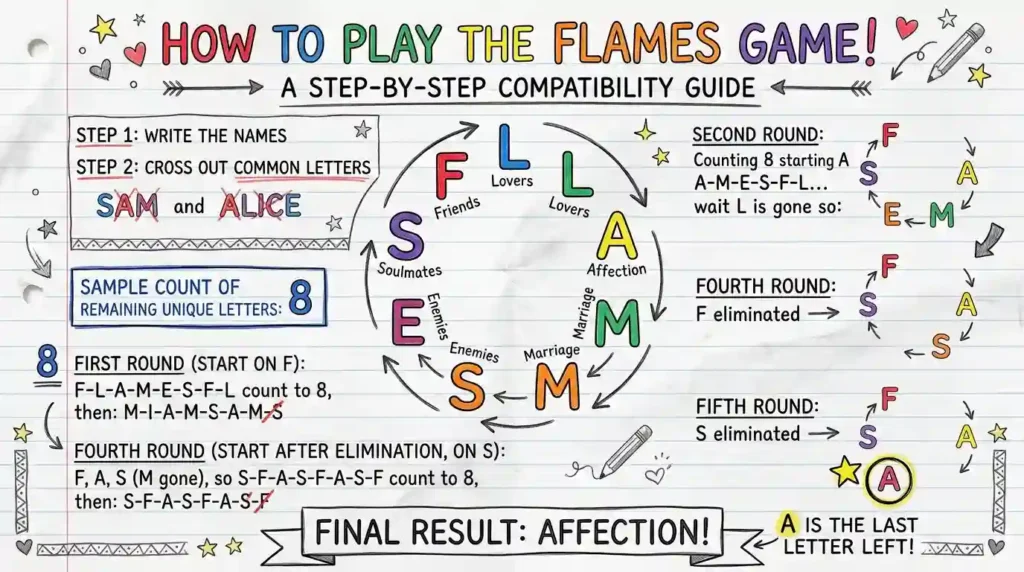
How to Play the FLAMES Love Test on Paper
FLAMES does not usually provide a numeric love percentage. Instead, it assigns a relationship category.
The letters represent:
| Letter | Relationship category |
| F | Friends |
| L | Lovers |
| A | Affection |
| M | Marriage |
| E | Enemies |
| S | Siblings or Soulmates, depending on the version |
Step 1: Write and Compare the Names
Write both names, identify common letters, and cross out matching pairs.
Step 2: Count All Remaining Letters
Add the uncancelled letters from both names. Suppose the remaining total is 8.
Step 3: Perform Circular Elimination
Write F L A M E S in a circle or straight line. Starting at F, count to 8. Remove the letter where the count ends.
Continue counting from the next available letter, wrapping around the sequence whenever necessary. Repeat until one letter remains.
This process is a form of circular elimination. Mathematically, it resembles modular elimination because the count repeatedly wraps around a shrinking set of options.
Step 4: Interpret the Remaining Letter
If the last letter is L, the game gives “Lovers.” If it is F, the result is “Friends,” and so on.
Different FLAMES traditions assign slightly different meanings to S. Decide whether it means “Siblings,” “Soulmates,” or another category before beginning.
How to Check Love Percentage on Paper Accurately
A paper love calculator is not scientifically accurate, but the arithmetic should still be internally consistent. Use the following practices to prevent accidental changes.
Choose One Name Format
Do not use a full name for one person and a first name for the other. Choose one of these approaches:
- Both first names
- Both full names
- Both commonly used nicknames
You can explore the difference between name and initial compatibility if you want to understand why initials and complete names may give different results.
Keep the Spelling Identical
A birthday variation, nickname, middle name, or alternate name spelling changes the letters. For example, “Sofia” and “Sophia” produce different letter counts.
Follow a Fixed Formula
Do not add the phrase TRUE LOVE in one attempt and omit it in another. A fixed formula is necessary for a deterministic result.
Count Repeated Letters Separately
Letter frequency refers to how many times a character appears, not simply whether it appears. If the combined names contain three E’s, the count is three.
Remove Non-Letter Characters
Spaces, hyphens, apostrophes, emojis, and numbers should normally be excluded unless your chosen method explicitly says otherwise.
Check Each Reduction Row
Copying one number incorrectly can alter the final percentage. Use small arrows to show which outside digits were paired. Once you understand the manual process, you can calculate love percentage by name online and compare the two results.
Common Mistakes That Change the Love Percentage
Mixing Different Methods
The TRUE LOVE method, letter-cancellation method, and FLAMES game do not follow the same rules. Avoid starting with one method and finishing with another.
Cancelling Too Many Letters
When cancelling common letters, match them one pair at a time. If one name contains two A’s and the other contains one A, only one pair should be removed.
Ignoring Repeated Letters
Each occurrence matters in a letter-counting method. Count all repeated letters rather than treating each character as unique.
Changing the Pairing Direction
If you begin by pairing outside digits, continue outside-in for every row. Do not suddenly switch to left-to-right pairs unless the selected method specifically requires it.
Forcing the Result Below 100
Some intermediate additions may create a value containing more than one digit. Do not discard digits simply to make the score look better. Apply the method’s stated number-reduction rule.
Treating Different Scores as Errors
An online calculator may use a hidden algorithm, name numerology, birthday variation, date of birth, letter positions, or a customized scoring table. Therefore, it may not match your handwritten result.
If you want a fast alternative, try our love calculator and treat both results as playful comparisons.
Why Different Paper Love Tests Give Different Results
There is no single internationally accepted formula for finding love percentage on paper. Most versions are playground games passed from one person to another. During that process, people adjust the rules.
One version may:
- Add the phrase TRUE LOVE to the names
- Count only letters in the names
- Cancel matching letters first
- Use adjacent-digit addition from left to right
- Pair the first and last digits
- Use first names only
- Include complete birth names
- Add numbers from a date of birth
As a result, asking how to take out love percentage on paper can lead to several correct instructions, depending on the game being played.
For comparable results, write down the complete rules. Anyone who uses the same names, spelling, normalization steps, letter counts, and number-reduction sequence should then obtain the same final percentage.
This makes the outcome reproducible, but reproducibility does not make it scientifically valid. It only means the game follows consistent arithmetic.
If you enjoy number tricks, you may also like learning how to write love on a calculator, another nostalgic activity that turns a simple calculation into a playful message.
Can Names Really Measure Relationship Compatibility?
No reliable scientific evidence shows that counting letters in two names can measure true love or predict whether a relationship will succeed.
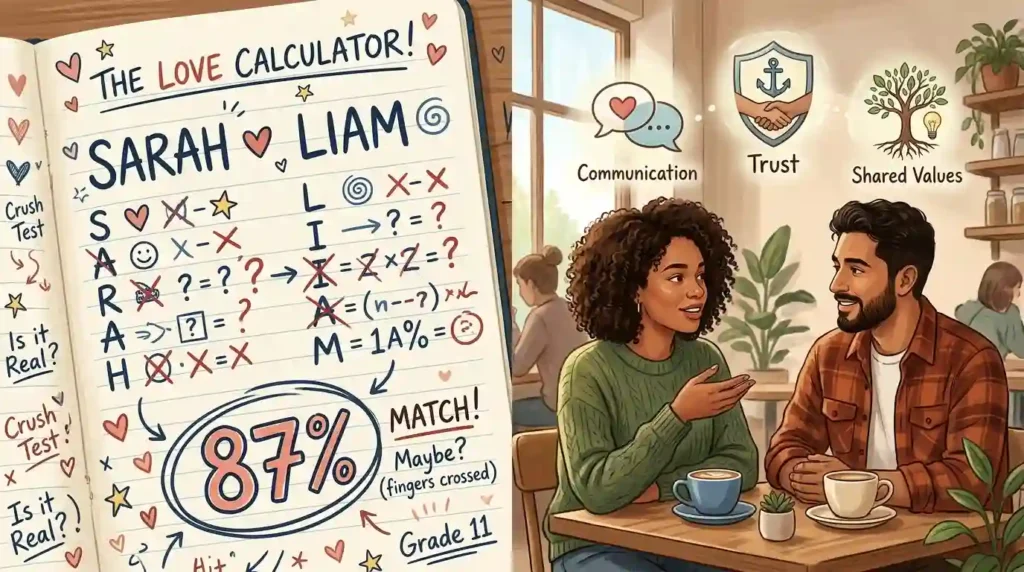
A person’s name does not reveal how they communicate, resolve disagreements, demonstrate trust, respect boundaries, or support a partner. A score also cannot measure shared values, emotional safety, long-term goals, affection, or commitment.
The American Psychological Association’s guidance on keeping romantic relationships healthy focuses on habits such as open communication, maintaining connection, and seeking appropriate help—not name-based percentages.
Therefore, a paper love test should be used for entertainment purposes. It can be a lighthearted activity at school, during a party, in a journal, or in a friendly conversation. However, it should not influence major relationship decisions.
If a result is low, it does not mean two people are incompatible. Likewise, a score of 99% does not guarantee a healthy relationship.
How to Interpret Your Final Love Percentage
There is no official scale, but the following playful interpretation can make the game more enjoyable:
| Love percentage | Fun interpretation |
| 0–20% | Very different energies |
| 21–40% | A connection worth exploring |
| 41–60% | A balanced or developing match |
| 61–80% | Strong playful compatibility |
| 81–99% | An exciting name match |
| 100% | A perfect paper-game score |
This score interpretation is deliberately lighthearted. A low result is not relationship advice, and a high compatibility score is not proof that someone is your soulmate.
A healthier real-life compatibility check involves asking questions such as:
- Can we communicate honestly?
- Do we respect each other’s boundaries?
- Are our important values compatible?
- Can we resolve conflict without insults or manipulation?
- Do we feel safe and supported?
- Are we both willing to put effort into the relationship?
Understanding what a love test means can help separate a fun game from a genuine assessment of relationship compatibility.
Ways to Make the Paper Love Test More Fun
Test Different Name Formats
Try first names, full names, and nicknames separately. Record each result instead of replacing the previous one. This demonstrates how name spelling changes the output.
Compare Multiple Methods
Calculate the TRUE total and LOVE total, try letter cancellation, and then play FLAMES. Comparing the methods reveals how strongly the chosen algorithm affects the answer.
Make a Results Page
Create a notebook table containing:
- Names tested
- Method used
- Starting counts
- Reduction rows
- Final percentage
- Date completed
This makes the activity easier to repeat.
Play with Friends
Ask each person to calculate the same pair independently. If everyone follows the fixed formula correctly, they should reach the same result. If the answers differ, compare the letter counts and reduction stages to find the arithmetic mistake.
Avoid Using the Test to Embarrass Someone
Do not use a crush’s name publicly if doing so could make that person uncomfortable. The game is most enjoyable when everyone involved understands that it is playful and harmless.
Conclusion
Learning how to do love percentage on paper is simple: prepare two consistently written names, apply one clearly defined letter-counting or cancellation method, and reduce the resulting numbers until you obtain a two-digit number or relationship category.
For a classic TRUE LOVE test answer, combine both names with the phrase TRUE LOVE, count the relevant letters, write those counts in order, and repeatedly add numbers from the outside inward. Other options include the LOVES method and the FLAMES game.
Whichever version you choose, remember that the result is entertainment, not scientific evidence. Real compatibility develops through communication, respect, trust, emotional understanding, shared values, and consistent behavior—not matching letters in two names.
Frequently Asked Questions
How do you do the true love test on paper?
Write both names with “TRUE LOVE,” count each TRUELOVE letter, list the totals, and repeatedly pair and add the outside digits until two remain.
How do you find love percentage on paper?
Use a fixed name-based letter-counting formula and reduce the resulting number sequence to a two-digit final percentage.
Should I use first names or full names?
Either works, but use the same format for both people. Using two full names usually provides more letters for the calculation.
Do spaces count in a paper love test?
No. Most versions remove spaces, punctuation, numbers, and other non-letter characters before counting.
Should repeated letters be counted?
Yes. In a frequency-based test, every occurrence of a letter contributes to its total count.
Why did I get a different answer the second time?
You may have changed the spelling, used another name format, miscounted repeated letters, or followed a different reduction method.
Can I use birthdays in a paper love test?
Yes, but that becomes a birthday or name-numerology variation and requires a separate date-of-birth formula.
Is the paper love test scientifically accurate?
No. It is a recreational name game and cannot scientifically measure attraction, commitment, or relationship success.
What does a low love percentage mean?
It means only that the selected formula produced a low number. It says nothing reliable about the real relationship.
Is FLAMES the same as a love percentage test?
No. FLAMES uses cancelled letters and circular elimination to produce a relationship category rather than a percentage.