
Summary
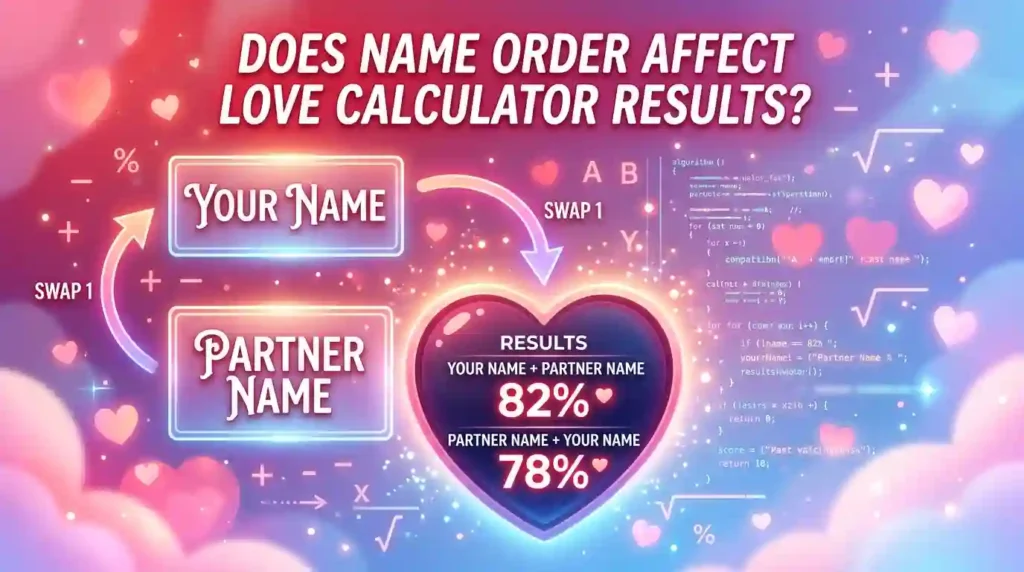
Many users wonder: Does Name Order Affect Love Calculator Results, or will the result stay the same if two names are swapped? The answer depends on how the love calculator is built. Some calculators use simple matching formulas where “Alex + Taylor” gives the same percentage as “Taylor + Alex.” Others use sequence-based algorithms, letter positions, numerology-style values, vowel/consonant patterns, or name-order logic that can slightly change the compatibility score. This guide explains why name order may matter, how different online love compatibility calculators work, and how users should interpret love percentage results in a fun, realistic, and balanced way.
Table of Content
- What Does a Love Calculator Actually Measure?
- Does Name Order Affect Love Calculator Results in Online Tools?
- Why Name Order Affect Love Calculator Results in Some Algorithms
- Common Methods Used in Name Compatibility Calculators
- Name Order vs Real Relationship Compatibility
- How to Test Love Calculator Results Fairly
- Should You Trust Love Calculator Percentages?
- Conclusion
- FAQs
What Does a Love Calculator Actually Measure?
A love calculator is an online entertainment tool that estimates romantic compatibility between two people based on entered names, birth dates, zodiac signs, or other simple inputs. The most common version is the name-based love calculator, where users enter two names and receive a love percentage, compatibility score, or relationship prediction.
A typical Love Calculator does not measure emotions, loyalty, communication, trust, or long-term relationship success in a scientific way. Instead, it uses a formula or algorithm to generate a fun compatibility result. This may include letter matching, character counting, name length, repeated alphabets, numerology-inspired values, vowel patterns, or symbolic calculations.
That is why two different love calculator websites may show different results for the same couple. One tool may show 91%, another may show 67%, and another may show a playful message like “perfect match” or “needs more understanding.” These differences usually happen because every tool uses its own compatibility logic.
In short, a love calculator measures a symbolic relationship score based on input patterns, not real emotional chemistry. It can be fun, interesting, and shareable, but it should not replace honest communication, mutual respect, emotional maturity, or real-life compatibility.
Does Name Order Affect Love Calculator Results in Online Tools?
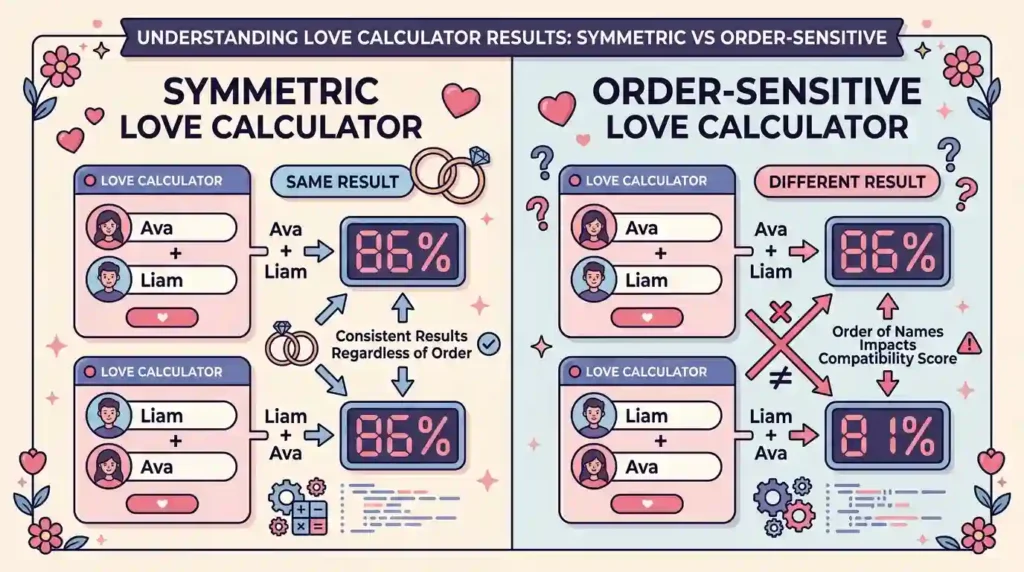
Yes, name order can affect love calculator results in some online tools, but not in all of them. The result depends on whether the calculator uses a symmetric or order-sensitive algorithm.
A symmetric love calculator treats both names equally. In this type of formula, the names “Emma and Daniel” and “Daniel and Emma” will usually produce the same result. The algorithm simply combines both names, counts letters, or compares shared characters without caring which name comes first.
An order-sensitive love calculator works differently. It may process the first name as “Person A” and the second name as “Person B.” If the formula assigns different roles to the first and second input fields, then changing the order can produce a different love percentage. For example, “Mia + Noah” might show 84%, while “Noah + Mia” might show 79%.
This does not mean one result is more accurate than the other. It simply means the tool’s calculation method is affected by sequence. The first name may be treated as the initiator, sender, emotional energy, or primary input, while the second name may be treated as the receiver, partner, or secondary input.
For users, this can be surprising. Many people expect name compatibility results to stay the same after swapping names. However, because love calculator tools are based on digital formulas, even a small change in input sequence can change the output.
Why Name Order Affect Love Calculator Results in Some Algorithms
The reason Name Order Affect Love Calculator Results in some systems is that algorithms often read data from left to right or process the first input differently from the second. Even though names may look simple to users, a calculator sees them as strings of letters, numbers, positions, and patterns.
For example, a love calculator may convert each letter into a number. A may equal 1, B may equal 2, C may equal 3, and so on. If the formula adds the first name, multiplies it by a factor, then compares it with the second name, changing the order can alter the final score.
Another tool may combine the names into one string. In that case, “SaraAli” is not the same string as “AliSara.” Even though both contain the same letters, the order of characters changes. If the algorithm reads letter positions, pairings, first letters, last letters, or middle letters, then the result can shift.
Some calculators may also use numerology-style name values. Numerology is commonly described as the study of the significance of numbers, especially in symbolic or mystical systems. Merriam-Webster defines numerology as the study of the occult significance of numbers. In name-based tools, this idea is often simplified into entertainment formulas where letters are assigned values and reduced into compatibility numbers.
This is why name order matters in some calculators but not others. The difference comes from the backend logic, not from the actual relationship.
Common Methods Used in Name Compatibility Calculators
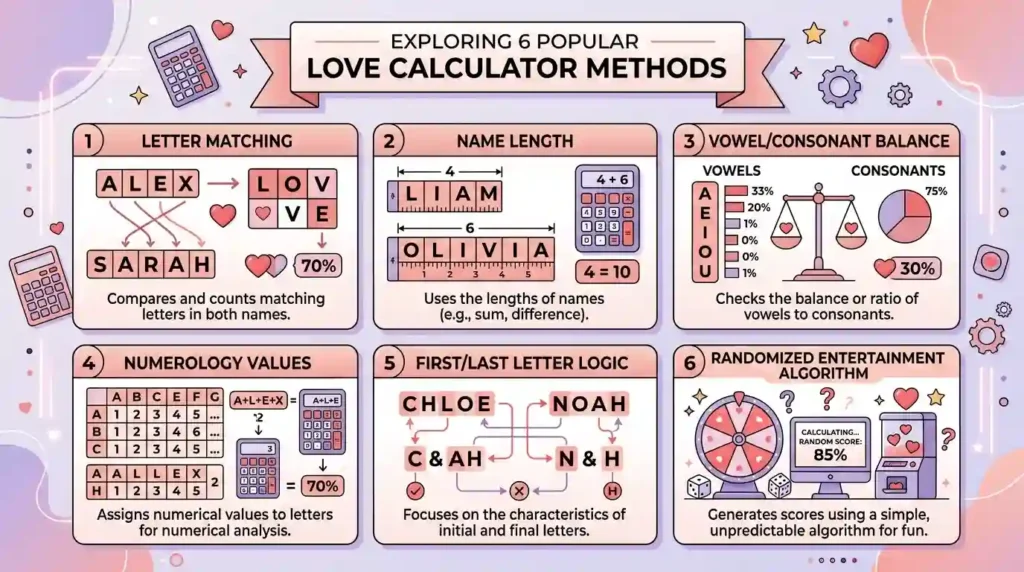
Different online love compatibility calculators use different methods to generate results. Understanding these methods helps explain why name order can sometimes change the final percentage.
1. Letter Matching Method
This method compares the letters in both names. It may count how many letters are shared, how often they appear, or whether both names contain similar alphabets.
For example, “Amelia” and “Liam” share several letters. A letter-matching calculator may interpret this as a stronger symbolic connection. If the tool only checks shared letters, name order may not affect the result. But if it checks the position of shared letters, the order may matter.
2. Name Length Comparison
Some calculators use the length of both names. A name with five letters and a name with six letters may produce a certain pattern. If the calculation simply adds both lengths, the order will not matter. But if it divides the first name length by the second name length, then swapping the names can change the score.
3. Vowel and Consonant Balance
A more detailed name compatibility calculator may check vowels and consonants. Vowels are often associated with emotion, softness, and expression in symbolic interpretations, while consonants may represent structure, strength, or personality.
For example, a calculator may compare the number of vowels in the first name with the number of vowels in the second name. If the formula is order-sensitive, the score may change when names are reversed.
4. Numerology-Inspired Calculation
Some love calculators convert letters into numbers. This may be inspired by numerology, name numbers, destiny numbers, or symbolic number meanings. In such formulas, each name receives a number, and the calculator compares both numbers to generate a love percentage.
If the formula treats both names equally, order will not matter. If it assigns different weight to the first name and second name, the result may change.
For a broader background on number symbolism, you can explore this authoritative resource on number symbolism by Britannica.
5. First Letter and Last Letter Logic
Some tools may give special importance to the first and last letters of each name. The first letter may be treated as personality energy, while the last letter may represent emotional closure or relationship outcome.
In this case, name order can matter because the first input may be given priority. For example, the first person’s initial may be compared against the second person’s final letter, creating a directional calculation.
6. Randomized Entertainment Algorithm
Some love calculators are mostly entertainment-based. They may use randomization, seeded values, or playful formulas to generate results. A seeded calculator may produce the same result for the same name pair, while a random one may change results every time.
In this case, name order might affect the result, but refreshes, spelling changes, capitalization, or added spaces may also influence the percentage.
Name Order vs Real Relationship Compatibility
Name order may affect a love calculator result, but it does not affect real love. A relationship is not built on whether “John + Emily” scores higher than “Emily + John.” Real compatibility depends on communication, emotional safety, shared values, honesty, respect, affection, trust, and commitment.
Online name compatibility tools are fun because they create curiosity. People enjoy checking their crush’s name, partner’s name, celebrity couple names, or even fictional character pairings. These tools can start conversations, create laughs, and make romantic moments more playful.
However, real relationships are much deeper than name patterns. Two people with a low love calculator score can still have a strong, healthy, long-lasting relationship. Similarly, two people with a high score may still struggle if they lack understanding, patience, or emotional maturity.
The best way to use a love calculator is to treat it as entertainment, not judgment. A percentage can be fun to share, but it should not create insecurity, arguments, or doubts. If the score changes when you reverse names, that simply means the tool uses an order-based formula.
For a deeper discussion of online compatibility accuracy, read How Accurate Are Name Compatibility Predictions Online.
How to Test Love Calculator Results Fairly
If you want to know whether name order affects a specific love calculator, you can test it yourself. This is a simple and useful method.
First, enter your name in the first field and your partner’s name in the second field. Write down the result. Then reverse the names and check again. If the score stays the same, the calculator is probably symmetric. If the score changes, it likely uses order-sensitive logic.
You can also test spelling variations. For example, try “Muhammad” vs “Mohammad,” “Sara” vs “Sarah,” or nicknames vs full names. Some calculators treat every spelling as a different input, so small changes can create different results.
Capitalization may or may not matter. A well-built calculator usually normalizes uppercase and lowercase letters, meaning “ALI” and “Ali” should be treated the same. But some simple tools may process characters exactly as entered.
Spaces can also matter. “Mary Jane” may not be treated the same as “MaryJane” if the calculator includes spaces in its formula. Special characters, emojis, dots, or extra symbols can also affect some tools.
To test fairly, use the same spelling, avoid extra spaces, and compare both name orders. This will help you understand whether the tool is consistent.
Simple Testing Example
Suppose you enter:
- Name 1: Sophia
- Name 2: Ethan
- Result: 88%
Then you reverse it:
- Name 1: Ethan
- Name 2: Sophia
- Result: 82%
This means the calculator is order-sensitive. The result changed because the tool processes the first and second input fields differently.
Now suppose the result is 88% both times. This means the tool likely treats the pair as equal, regardless of name order.
Should You Trust Love Calculator Percentages?
You can enjoy love calculator percentages, but you should not fully trust them as relationship predictions. A love score is not the same as emotional compatibility. It cannot know your conversations, memories, sacrifices, conflicts, values, or future goals.
A love calculator can be useful in the following ways:
- It can be a fun activity for couples.
- It can make romantic conversations more playful.
- It can help people explore name compatibility in a lighthearted way.
- It can increase curiosity about names, initials, and symbolic meanings.
- It can be entertaining for social media, friends, and crush-related moments.
But it cannot tell you whether someone truly loves you. It cannot measure loyalty, emotional intelligence, respect, honesty, or long-term commitment. These qualities are shown through actions, not percentages.
If you receive a low score, do not panic. If you receive a high score, do not assume the relationship will be perfect. The best interpretation is: “This is fun, but real compatibility depends on real connection.”
Practical Tips for Better Love Calculator Use
To get the most enjoyable and consistent results from a love calculator, follow these simple tips.
Use Full Names for More Detailed Results
Full names provide more letters, which may give the algorithm more data to process. If a calculator uses letter frequency, numerology values, or name length, full names may produce a more detailed symbolic result.
Try Nicknames for Fun
Nicknames can create interesting results because they reflect emotional closeness. For example, a partner may be known by a short name, pet name, or affectionate nickname. Testing both official names and nicknames can make the experience more entertaining.
Avoid Extra Spaces or Symbols
Extra spaces, punctuation, emojis, or decorative characters may affect the result in some calculators. Use clean name input for a more consistent score.
Compare Both Name Orders
If you are specifically curious whether name order affects the result, always test both versions. This gives you a clearer understanding of how the tool works.
Do Not Overthink the Percentage
A love calculator is not a relationship test. It is a digital compatibility game. Use it for fun, not as proof of love or rejection.
The Psychology Behind Love Calculator Curiosity
People love compatibility tests because they offer quick answers to emotional questions. When someone has a crush, is starting a new relationship, or wants reassurance, a love calculator can feel exciting. It gives an instant result, and that result can feel meaningful even when it is only symbolic.
This curiosity is natural. Humans often look for signs, patterns, and confirmation in romantic situations. Names feel personal, so a name compatibility result feels more intimate than a random score. Seeing two names together on a screen can create emotional excitement.
However, this emotional reaction does not mean the calculator is scientifically accurate. It simply means the tool connects with human curiosity, hope, and imagination. That is why love calculators remain popular across social media, dating blogs, relationship websites, and entertainment platforms.
Does a Higher Love Score Mean a Better Match?
A higher score can feel exciting, but it does not guarantee a better relationship. A 95% love calculator result may look impressive, but real-life compatibility depends on daily behavior.
A strong relationship usually includes:
- Trust during difficult moments.
- Respect for boundaries.
- Healthy communication.
- Emotional support.
- Shared values and goals.
- Ability to solve conflicts.
- Mutual attraction and affection.
- Consistency over time.
A love calculator cannot observe these things. It only calculates based on names or other limited input. Therefore, a high score should be enjoyed as a fun result, not treated as a promise.
At the same time, a low score should not discourage you. Many successful couples may get low or average love calculator results simply because their names do not match the tool’s formula well.
Conclusion
So, does name order affect love calculator results? The answer is yes, sometimes. If a love calculator uses an order-sensitive algorithm, reversing the names can change the compatibility percentage. If it uses a symmetric formula, the result will remain the same no matter which name comes first.
The important thing to remember is that love calculator results are based on digital formulas, symbolic patterns, and entertainment logic. They can compare letters, name length, vowels, consonants, numerology-inspired values, and input sequence, but they cannot measure real emotions or relationship quality.
If your result changes after reversing the names, do not worry. It only means the calculator reads the first and second name differently. Use the score as a fun romantic activity, not as a serious relationship decision.
A love calculator can make relationships more playful, but real love is built through trust, communication, respect, care, and shared effort.
FAQs
1. Does name order affect love calculator results?
Yes, name order can affect love calculator results if the tool uses an order-sensitive formula. Some calculators treat the first and second name differently, which can change the final percentage.
2. Why does my love calculator score change when I reverse names?
Your score may change because the calculator processes names in sequence. It may assign different values to the first name and second name, or it may read combined letters in a specific order.
3. Should the love percentage be the same for both name orders?
Not always. In a symmetric calculator, the result should be the same. In an order-sensitive calculator, the result may be different.
4. Which result is correct if the names give two different scores?
Neither result should be treated as completely correct or incorrect. Love calculator scores are for entertainment. If two results appear, you can average them or simply enjoy both.
5. Can a love calculator predict true love?
No, a love calculator cannot accurately predict true love. It can only generate a compatibility score based on names or other simple inputs. Real love depends on emotions, actions, values, and commitment.
6. Do spelling changes affect love calculator results?
Yes, spelling changes can affect results. “Sara” and “Sarah” may produce different scores because the letters are different.
7. Do nicknames work in love calculators?
Yes, nicknames can be used. In fact, testing nicknames can be fun because they may reflect the emotional bond between two people.
8. Is a high love calculator score meaningful?
A high score is fun and exciting, but it does not guarantee relationship success. Real compatibility depends on communication, trust, respect, and shared values.
9. What should I do if my love score is low?
Do not worry. A low score does not mean your relationship is weak. It only means your names produced a lower result in that specific calculator.
10. How can I know if a love calculator uses name order?
Enter the same two names twice, once in normal order and once in reverse order. If the result changes, the calculator uses name-order logic.