
Summary
The choice between a first name and a complete name can noticeably change a love calculator result because each format gives the algorithm a different amount of text to process. First Name vs Full Name in Love Compatibility Calculation is not simply a question of which option produces the higher score. It is about consistency, the purpose of the test, the calculation method, and how accurately the entered name represents the person. First-name calculations are fast, simple, and useful for casual comparisons. Full-name calculations provide more letters and possible numerical values, but they can also introduce complications involving middle names, surnames, spelling variations, transliteration, and privacy. The most useful approach is to understand how the calculator handles names, use the same format for both partners, and treat the result as entertainment rather than a prediction of relationship success.
Table of Contents
- First Name vs Full Name in Love Compatibility Calculation: What Changes?
- How First Name-Based Love Compatibility Works
- How Full Name-Based Love Compatibility Works
- Factors That Can Change a Name Compatibility Score
- First Name vs Full Name in Love Compatibility Calculation: Which Is Better?
- Does a Full Name Make a Love Calculator More Accurate?
- Best Practices for Entering Names
- Common Myths About Name Compatibility
- Conclusion
- FAQs
First Name vs Full Name in Love Compatibility Calculation: What Changes?
A name compatibility calculator converts text into a score, pattern, or symbolic interpretation. Depending on the tool, it may compare letters, assign numerical values, count vowels and consonants, calculate repeated characters, apply numerology rules, or combine several methods.
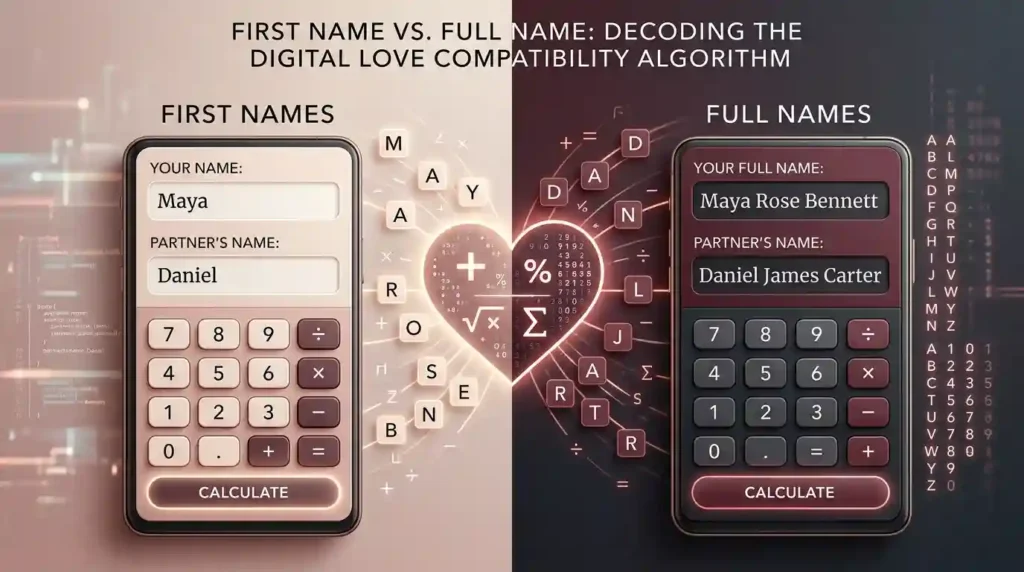
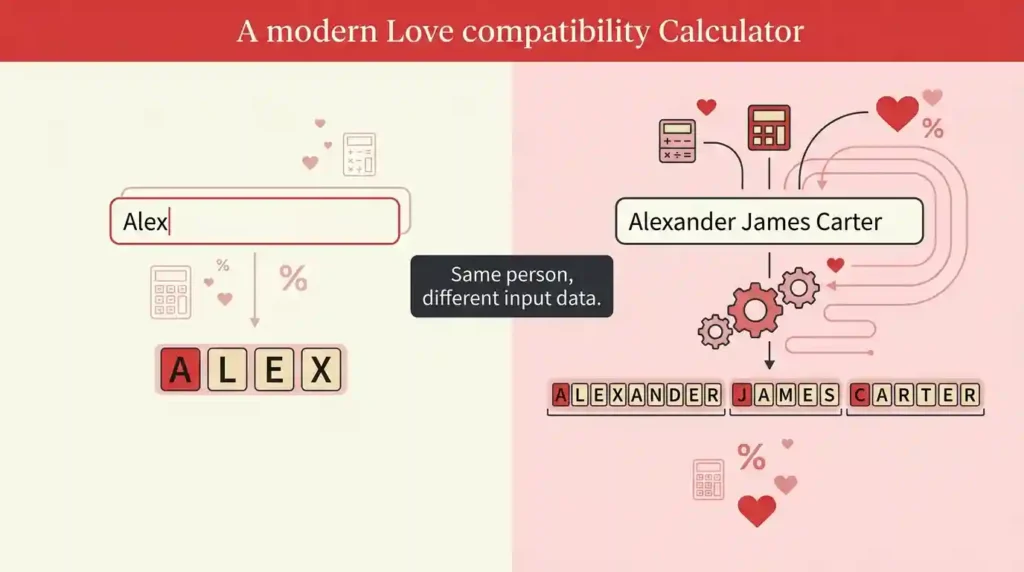
That means the name format matters. Entering “Alex” gives the calculator four letters. Entering “Alexander James Carter” gives it far more characters, repeated letters, initials, vowels, consonants, and possible number values. Even when both entries refer to the same person, the underlying data is different, so the resulting compatibility percentage may also be different.
The key distinction is not that one input is automatically correct and the other is wrong. The real question is whether the selected format matches the calculator’s intended method.
First Names Represent Everyday Identity
A first name is usually the simplest representation of a person. It may be the name friends, partners, and family members use in ordinary conversation. For a casual love compatibility test, that familiarity can make the result feel more personal and relevant.
First names also reduce ambiguity. There is no need to decide whether to include a middle name, maiden name, married surname, compound family name, suffix, or professional title. Both people can enter the names they normally use and receive a quick comparison.
Full Names Provide More Calculation Data
A full name gives an algorithm a larger data set. In a letter-based system, every added character can affect the result. In name numerology, each component may contribute to a total number, expression number, or other symbolic value. In a custom matching formula, additional characters can change frequency, sequence, and similarity patterns.
More data, however, does not automatically mean more truth. A longer input may create a more detailed calculation while still remaining a symbolic or entertainment-based result.
How First Name-Based Love Compatibility Works
A first-name test usually processes only the names by which two people are commonly known. For example, a user might enter “Maya” and “Daniel” rather than their legal names.
The exact formula varies by calculator. Some tools create a score from shared letters. Others convert letters into numbers, compare character positions, analyze vowels and consonants, or use a deterministic formula that always produces the same result for the same pair of names.
To see how a simple name comparison feels in practice, users can try the Free Love Calculator with the same pair of first names more than once. A well-designed deterministic calculator should return a consistent result when the spelling and input format remain unchanged.
Advantages of Using First Names
First names are convenient because they are:
- Easy to remember and enter
- Less sensitive than complete legal names
- More suitable for quick mobile use
- Consistent with how many couples address each other
- Easier to compare across several tests
- Less affected by surname changes after marriage
A first-name approach is especially suitable for lighthearted quizzes, early-stage dating conversations, social sharing, or curiosity about a crush.
Limitations of Using First Names
The simplicity of first names also creates limitations. Many people share the same first name, and some use nicknames that differ significantly from their birth names. “Liz,” “Beth,” and “Elizabeth” may refer to the same person but generate different letter and number patterns.
A first name can also be culturally incomplete. In some naming traditions, identity is represented through multiple linked names rather than a single personal name. A calculator designed around a Western first-name and surname model may not handle every naming convention fairly or consistently.
How Full Name-Based Love Compatibility Works
A full-name calculation typically uses a person’s first name, middle name or names, and surname. Some systems ask for the birth name, while others may accept a current legal name or the name most commonly used.
The benefit is that the algorithm receives more characters to process. This can create a more complex numerical or letter-based profile. The drawback is that users must make several decisions before entering the name.
Which Full Name Should Be Used?
“Full name” can mean different things:
- Name at birth
- Current legal name
- Married name
- Professional name
- Religious or ceremonial name
- Full name without a middle name
- Full name with multiple surnames
- Transliteration used in English
A calculator cannot resolve these identity questions on its own. It simply processes the text provided. If one partner enters a birth name and the other enters a nickname plus surname, the inputs are not based on the same rule.
Full Names Can Increase Variation
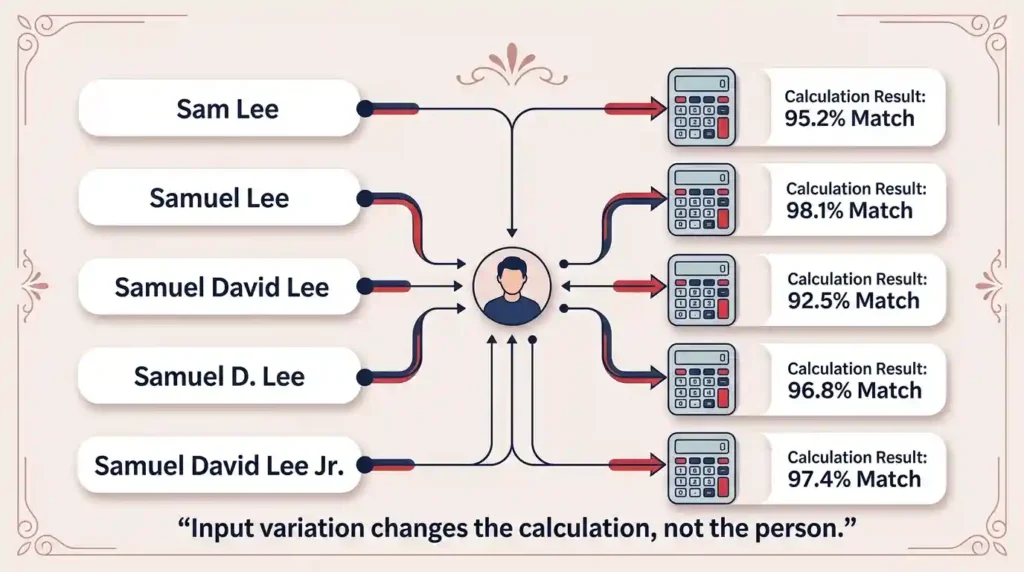
Consider one person who may be entered as:
- Sam Lee
- Samuel Lee
- Samuel David Lee
- Samuel D. Lee
- Samuel David Lee Jr.
Each version can produce a different score because punctuation, spaces, initials, suffixes, and added letters may be treated differently by the algorithm. This does not mean the person’s romantic compatibility has changed. It means the text input has changed.
Readers who want a deeper explanation of the mechanics can review How Name Compatibility Tests Actually Work in Love Calculators, which explains why formulas, spelling, and input normalization can influence the final percentage.
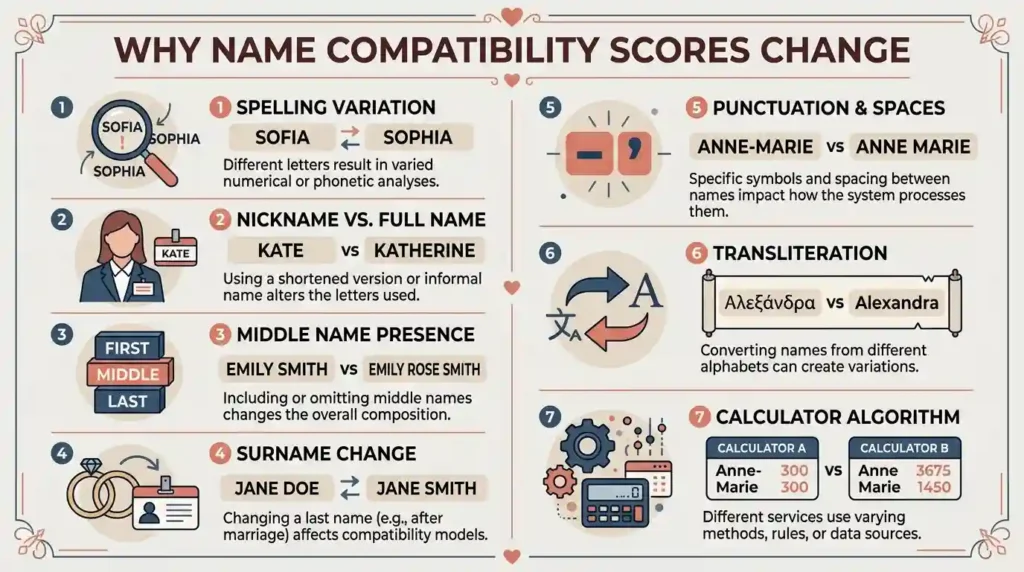
Factors That Can Change a Name Compatibility Score
The first-name versus full-name decision is only one variable. Several technical and personal factors can influence the output.
1. Spelling Variations
Small spelling changes can alter a result. “Sofia” and “Sophia” sound similar, but a letter-based formula sees different character sequences. The same applies to “Mohammad,” “Muhammad,” and “Mohammed.”
A useful calculator should explain whether it treats spelling literally. Most simple tools do, which means users should enter names consistently.
2. Nicknames and Shortened Names
Nicknames may better reflect a person’s social identity, but they can produce a very different score from the formal name. A couple using “Kate” and “Will” may receive a different result from “Katherine” and “William.”
Neither version should be treated as objectively superior. The right choice depends on whether the test is intended to represent everyday identity or formal identity.
3. Middle Names
Middle names add characters and may significantly affect numerology totals or letter counts. If middle names are included for one person, they should generally be included for the other person as well. Using unequal formats makes the comparison less consistent.
4. Surnames and Name Changes
Surnames can change through marriage, divorce, adoption, personal choice, or cultural practice. A result based on a current surname may differ from one based on a birth surname.
This is a calculation issue, not evidence that a relationship changed when a name changed. The algorithm is responding to a new text string.
5. Spaces, Punctuation, and Capitalization
Different calculators normalize input differently. One may ignore spaces, hyphens, apostrophes, accents, and capitalization. Another may process some of these characters.
For example:
- Anne-Marie
- Anne Marie
- annemarie
- ANNE-MARIE
A carefully built tool will usually standardize these inputs before calculation, but users should not assume every calculator follows the same normalization rules.
6. Transliteration and Non-Latin Scripts
Names written in Arabic, Urdu, Hindi, Chinese, Japanese, Cyrillic, or other scripts may have several Romanized spellings. Transliteration can change the number and order of letters even when pronunciation remains similar.
For a fair comparison, both names should be entered in the same script and according to a consistent transliteration style. If the calculator supports native scripts, users should follow its instructions rather than improvising between writing systems.
7. The Algorithm Itself
Two websites can produce different percentages from identical names because they use different formulas. One may rely on letter frequency, another on numerology, and another on a custom hash or scoring method.
This is why a compatibility percentage should be interpreted within the context of the specific calculator. It is not a universal measurement that can be transferred from one platform to another.
First Name vs Full Name in Love Compatibility Calculation: Which Is Better?
The better choice depends on the purpose of the test and the design of the calculator.
| Situation | Recommended Input | Reason |
| Quick, casual compatibility check | First names | Simple, familiar, and easy to repeat |
| Comparing several couples for fun | First names | Keeps the input format consistent |
| Numerology-style name analysis | Full names, if requested | Some systems assign meaning to every letter in the complete name |
| Privacy-conscious use | First names | Shares less personal information |
| Testing the effect of name variations | Both formats | Shows how the algorithm responds to different inputs |
| Calculator gives explicit instructions | Follow the stated format | The formula may be designed for a specific name type |
Use First Names for Simplicity
First names are usually the best default when a calculator does not specify a format. They minimize data entry, reduce privacy concerns, and make it easier to repeat the test.
For most entertainment-focused compatibility tools, users are interested in a quick interaction rather than a formal identity analysis. First names meet that expectation.
Use Full Names When the Method Requires Them
A full name is appropriate when the calculator specifically says that its formula is based on the complete birth name or legal name. This is common in numerology-inspired systems where each letter is assigned a value.
Even then, users should follow one consistent standard. If the tool requests birth names, both partners should use birth names. If it requests current full names, both should use current full names.
Compare Both Formats for Insight Into the Tool
One practical method is to run two separate calculations:
- First name with first name
- Full name with full name
The difference between the two scores can reveal how sensitive the tool is to additional letters. It should not be interpreted as two competing verdicts about the relationship.
Does a Full Name Make a Love Calculator More Accurate?
A full name can make a calculation more detailed, but “detailed” and “accurate” are not the same thing.
Accuracy requires a meaningful standard against which the result can be tested. A love calculator can consistently process names and return a repeatable percentage, but that does not establish that the percentage predicts attraction, commitment, communication, or long-term relationship success.
Technical Consistency Versus Relationship Validity
A calculator may be technically consistent if it:
- Produces the same result for the same input
- Handles spaces and capitalization predictably
- Applies the same formula to every user
- Explains which name format should be entered
- Avoids random score changes
These are signs of a stable calculation. They are not proof that names determine romantic outcomes.
What Actually Matters in a Relationship
Real compatibility develops through communication, trust, shared values, emotional safety, respect, conflict management, expectations, life goals, and mutual effort. A name score cannot observe how two people listen to each other, manage disagreement, support each other, or make decisions.
The American Psychological Association’s guidance on healthy relationships identifies communication as a key part of maintaining a healthy partnership. That is a more useful real-world consideration than whether a calculator returns 62 percent or 91 percent.
Name compatibility tools can still be enjoyable. Their value lies in entertainment, conversation, and curiosity, not diagnosis or prediction.
Best Practices for Entering Names
Users can get a more consistent and meaningful experience by following a few simple rules.
Use the Same Format for Both People
Do not compare one first name with another person’s full legal name. Use first name with first name, or full name with full name.
Follow the Calculator’s Instructions
If a tool requests birth names, current names, or first names only, use the stated format. The formula may have been designed around that input structure.
Keep Spelling Consistent
Use the spelling each person normally uses. Avoid changing spellings merely to obtain a higher score. Doing so tests the sensitivity of the algorithm, not the quality of the relationship.
Test Nicknames Separately
When a nickname is central to someone’s identity, run it as a separate comparison. Label the result mentally as a nickname-based score rather than mixing it with the formal-name calculation.
Protect Personal Information
A full legal name is personal data. Before entering it into any website, consider whether the tool needs that information, whether the site appears trustworthy, and whether a first name would be sufficient.
For a casual compatibility test, sharing less information is usually the more sensible option.
Focus on Patterns, Not a Single Percentage
A score can be a conversation starter. It should not decide whether to begin, continue, or end a relationship. A low result does not invalidate genuine affection, and a high result does not guarantee emotional compatibility.

Common Myths About Name Compatibility
Myth 1: A Full Name Always Gives the True Result
A full name provides more characters, not guaranteed truth. The result still depends on the formula, input rules, and interpretation.
Myth 2: The Highest Score Must Be the Correct One
Trying several spellings until a preferred percentage appears is a form of result shopping. The higher number is not automatically more meaningful.
Myth 3: Married Surnames Improve or Reduce Compatibility
A surname change alters the input text. It does not independently change emotional connection, shared history, or relationship behavior.
Myth 4: Different Calculators Should Agree
Different tools may use different algorithms, so disagreement is expected. There is no single universal name compatibility formula.
Myth 5: A Low Score Is a Warning Sign
A calculator does not know the couple. It cannot assess kindness, honesty, boundaries, attraction, communication, or mutual commitment. A low percentage is not evidence of a relationship problem.
Myth 6: A High Score Predicts a Lasting Relationship
A high score can be fun and flattering, but it cannot guarantee long-term success. Relationships are shaped by choices and behavior, not only by names.
Conclusion
The debate over first names and full names is best understood as an input-format question rather than a test of romantic destiny. First names are practical, familiar, and privacy-friendly. Full names offer more letters and a more complex calculation, but they also introduce uncertainty around middle names, surnames, nicknames, transliteration, and legal name changes.
For most casual love calculator uses, first names are the clearest default. When a calculator specifically requires complete birth names or legal names, follow its instructions and apply the same rule to both partners. Users who compare both formats should expect different scores because the algorithm is processing different text.
Most importantly, treat name compatibility as entertainment. A percentage can spark curiosity or conversation, but it cannot replace communication, respect, trust, emotional maturity, and shared effort.
FAQs
Should I Use My First Name or Full Name in a Love Calculator?
Use first names when the calculator does not provide specific instructions. Use full names only when the tool says its method requires them. Whichever option you choose, use the same format for both people.
Why Does My Compatibility Score Change When I Enter a Full Name?
The added middle name and surname introduce more letters, numerical values, and character patterns. The calculator processes a different input string, so the score may change.
Is a Full-Name Love Compatibility Result More Accurate?
Not necessarily. It may be more detailed within a specific formula, but it is not scientifically more capable of predicting a relationship. More input data does not automatically create real-world validity.
Should I Use a Birth Name or Married Name?
Follow the calculator’s instructions. If it asks for a birth name, use the birth name for both partners. If no guidance is given, first names are usually simpler and more consistent.
Can I Use a Nickname in a Name Compatibility Test?
Yes. A nickname can represent the identity used in everyday life. However, it may produce a different score from the formal name, so test it separately and interpret the difference as an input change.
Do Middle Names Affect Love Compatibility Scores?
They can affect the calculated percentage when the formula processes every letter. Their inclusion changes the text data, but it does not prove that the relationship itself is more or less compatible.
What If My Name Has Different English Spellings?
Choose one consistent transliteration, preferably the spelling you normally use. Enter both partners’ names using the same script and formatting approach whenever possible.
Can Punctuation or Capitalization Change the Result?
It depends on the calculator. Some tools ignore spaces, hyphens, apostrophes, and capital letters, while others may process them. Use standard spelling and follow any formatting instructions shown by the tool.
Why Do Different Love Calculators Show Different Scores?
Each calculator may use a different formula, such as letter matching, numerology, character frequency, or a custom scoring method. The percentages are therefore not directly comparable across platforms.
Can a Name Compatibility Score Predict Marriage Success?
No. A name-based score cannot assess communication, trust, values, conflict resolution, emotional safety, or shared goals. It should be used for entertainment rather than major relationship decisions.