
Summary
Millions of people type their names into a love calculator every day, hoping for a glimpse into romantic compatibility. But is a Love Calculator Accurate for Real Relationships, or is it simply a fun digital distraction? This article digs deep into the psychology behind love calculators, the science of compatibility, and what these tools can — and cannot — tell you about your relationship. Whether you’re a hopeless romantic or a healthy skeptic, understanding the difference between algorithmic matching and genuine emotional connection is essential in today’s digital dating landscape.
Table of Contents
- What Is a Love Calculator?
- How Does a Love Calculator Work?
- Is Love Calculator Accurate for Real Relationships? — The Big Question
- The Psychology Behind Why We Trust These Tools
- What Real Relationship Compatibility Actually Means
- Love Calculator Accurate for Real Relationships: What the Numbers Can and Cannot Tell You
- Can a Love Score Influence Your Relationship Mindset?
- How to Use a Love Calculator the Right Way
- When Love Calculators Become Harmful
- Conclusion
- FAQs
What Is a Love Calculator?
A love calculator is a digital tool — typically a web-based application — that takes two names, birthdates, or zodiac signs as input and produces a compatibility percentage or score as output. These tools have been around since the early days of the internet, evolving from simple text-based calculators into visually rich, emotionally engaging experiences.
Today, platforms like love calculator online offer users an instant compatibility reading with personalized messaging, making the experience feel more meaningful than ever before.
Love calculators tap into one of humanity’s oldest desires: the wish to know whether a particular person is “meant” for us. From ancient astrology to modern matchmaking algorithms, people have always sought external validation for their romantic feelings.
How Does a Love Calculator Work?
Most love calculators use one or more of the following methods to generate a score:
Name-Based Algorithms
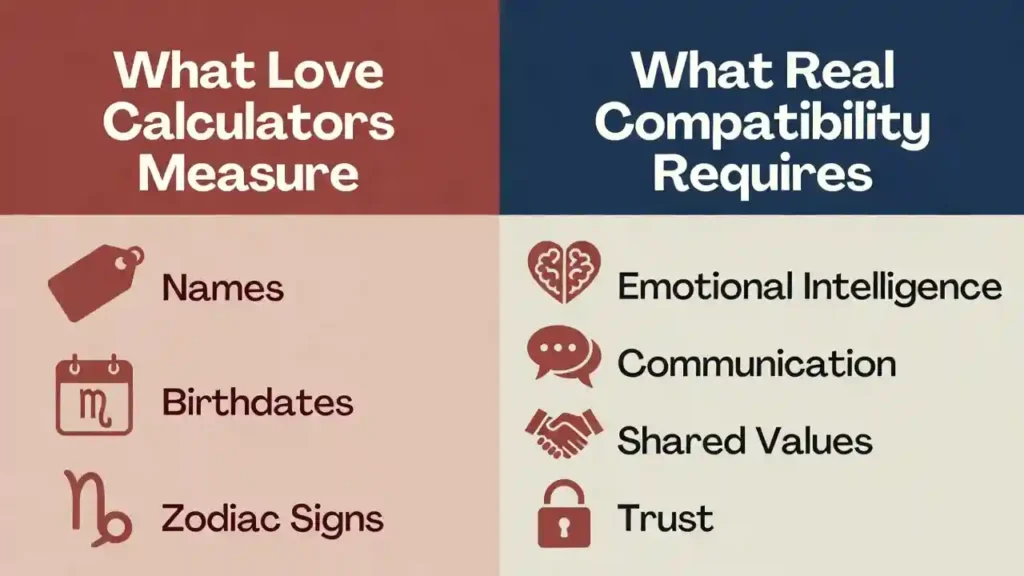
The most common method assigns numerical values to each letter of both names using a pre-set formula — often derived from the FLAMES game or letter-frequency analysis. These numbers are then reduced through a series of arithmetic operations to produce a percentage.
Numerology-Based Matching
Some calculators convert names or birthdates into numerological “life path numbers.” Each number (1 through 9, plus master numbers 11, 22, 33) carries a specific personality archetype. When two life path numbers are compared, the tool identifies natural affinities or friction points.
Astrology and Zodiac Compatibility
Many tools factor in sun signs, moon signs, or full birth charts. Aries and Leo, for example, are considered highly compatible in traditional astrology, while Aries and Cancer may receive a lower score due to perceived elemental friction.
Machine Learning Approaches
A newer generation of relationship apps uses machine learning to analyze behavioral patterns, communication styles, and shared interests. These systems provide more nuanced outputs but still cannot fully replicate human emotional complexity.
None of these methods have been validated by peer-reviewed psychological research as reliable predictors of real-world romantic success.
Is Love Calculator Accurate for Real Relationships? — The Big Question
This is the question everyone is really asking. Let’s be direct: no love calculator is scientifically accurate for predicting real relationship outcomes. Here’s why.
The Problem of Algorithmic Simplicity
Human relationships are extraordinarily complex systems. They involve emotional intelligence, trauma histories, communication patterns, shared values, physical chemistry, life goals, family dynamics, and hundreds of other variables. Reducing this complexity to a single percentage based on two names is, by definition, an oversimplification.
Dr. John Gottman, the renowned relationship psychologist at the University of Washington, spent decades studying couples and identified specific behavioral markers — what he calls the “Four Horsemen” (criticism, contempt, defensiveness, and stonewalling) — as predictors of relationship failure. None of these markers can be detected by a name-based algorithm.
What Research Says About Compatibility
According to research published in Psychological Science, the factors most predictive of relationship satisfaction include:
- Emotional responsiveness — how well partners attune to each other’s needs
- Attachment style — whether both partners feel secure or anxious in relationships
- Conflict resolution skills — the ability to repair after disagreements
- Shared meaning-making — building rituals, traditions, and a shared narrative
None of these dimensions are measurable through a love calculator’s input fields.
The Psychology Behind Why We Trust These Tools
If love calculators aren’t scientifically valid, why do millions of people use them every day — and why do the results feel meaningful?
The Barnum Effect
Psychologists use the term “Barnum Effect” (also known as the Forer Effect) to describe our tendency to accept vague, generalized personality descriptions as uniquely accurate. When a love calculator says “You and your partner share a deep emotional bond and will face some communication challenges,” most couples will nod in agreement — because this describes virtually every relationship.
Confirmation Bias in Romance
When we’re already attracted to someone, we want confirmation that the feeling is mutual and “destined.” A high compatibility score reinforces what we hope is true. A low score, on the other hand, is often dismissed as inaccurate — which reveals that we’re using the tool for emotional validation, not genuine guidance.
The Novelty of Quantified Romance
There’s also something genuinely pleasurable about gamifying emotion. Seeing “78% compatible” triggers a small dopamine response. It’s entertaining, shareable, and emotionally lightweight — which is precisely why these tools go viral on social media platforms.
What Real Relationship Compatibility Actually Means
Real compatibility isn’t a static number — it’s a dynamic, evolving quality that grows through intentional effort, mutual respect, and continuous learning about your partner.
Emotional Compatibility
Emotional compatibility refers to how well two people understand and respond to each other’s inner worlds. Partners with high emotional compatibility can sit with difficult feelings without becoming defensive or dismissive.
Values Compatibility
Shared values — around family, finances, spirituality, ambition, and lifestyle — are among the strongest predictors of long-term relationship satisfaction. Two people can be wildly different in personality yet deeply compatible in values.
Communication Style Matching
Research consistently shows that couples who communicate openly, honestly, and with curiosity tend to navigate conflict more successfully. Communication style is learnable, meaning even mismatched couples can grow into greater compatibility over time.
Physical and Intellectual Chemistry
While often underemphasized in compatibility models, physical chemistry and intellectual stimulation are important components of romantic fulfillment. These too cannot be measured by a name-based algorithm.
Love Calculator Accurate for Real Relationships: What the Numbers Can and Cannot Tell You

What the Numbers CAN Tell You
- They provide a conversation starter. Sharing a love calculator result with a partner can open up playful, low-stakes conversations about compatibility and preferences.
- They offer entertainment value. Used lightheartedly, these tools provide a fun, engaging experience without harmful consequences.
- They can spark self-reflection. A low score might prompt someone to think about what they genuinely want in a partner — not because the algorithm is right, but because it prompted introspection.
What the Numbers CANNOT Tell You
- Whether your partner will remain faithful during hardship
- How both of you will handle grief, illness, or financial stress
- Whether your attachment styles are compatible
- How you’ll both grow and change over the next decade
For a deeper understanding of how to interpret these scores in a healthy way, check out this guide on how to Read Your Love Compatibility Score Correctly — it provides practical, grounded advice for contextualizing any compatibility result.
Can a Love Score Influence Your Relationship Mindset?
This is where love calculators can cross from harmless fun into potentially damaging territory.
The Self-Fulfilling Prophecy Risk
If a person receives a very high compatibility score, they may unconsciously lower their critical thinking about genuine red flags in the relationship. Conversely, a low score might introduce unnecessary doubt into an otherwise healthy partnership.
Relationship therapists often note that external validation tools — whether horoscopes, personality tests, or love calculators — can create cognitive anchors that are hard to dislodge, even when lived experience contradicts them.
Anxiety and Reassurance-Seeking
For individuals with anxious attachment styles, love calculators can become part of a reassurance-seeking loop. Checking the score repeatedly, trying different name variations, or adjusting inputs to get a higher number are signs that the tool is feeding anxiety rather than reducing it.
How to Use a Love Calculator the Right Way
If you enjoy love calculators, there’s absolutely nothing wrong with using them — as long as you maintain a healthy perspective.

Tips for Healthy Use
- Treat it as entertainment, not prophecy. A score is not a verdict on your love life.
- Discuss it openly with your partner. Use the result as a springboard for real conversation about what compatibility means to both of you.
- Combine it with real reflection. Ask yourself: Do we communicate well? Do we share core values? Do I feel emotionally safe with this person?
- Don’t make decisions based on a score. Never end or begin a relationship because of a calculator result.
- Use quality tools. Some platforms are more thoughtfully designed than others. A well-built love calculator online will frame results in a constructive, non-alarmist way.
When Love Calculators Become Harmful
While most users engage with love calculators casually, certain patterns of use warrant attention.
Signs of Unhealthy Engagement
- Checking multiple calculators for the same person, hoping for different results
- Feeling significant distress over a low compatibility score
- Using a low score to justify ending a relationship you otherwise valued
- Sharing results with a partner in a manipulative or hurtful way
If any of these patterns resonate, it may be worth speaking with a relationship counselor or therapist. According to the American Psychological Association, healthy relationships are built on communication, mutual respect, and trust — none of which can be outsourced to an algorithm.
Conclusion
So, is a love calculator accurate for real relationships? The honest answer is: not in any scientifically meaningful way. These tools are best understood as playful, entertaining experiences that tap into our deep human desire for romantic certainty. They can spark fun conversations and prompt light self-reflection — but they should never be mistaken for a genuine measure of relationship potential.
Real love is built in the quiet moments of showing up for each other, in the difficult conversations, in the growth that happens when two people choose each other repeatedly over time. No algorithm can capture that.
Use love calculators for the fun they provide, but invest your real energy into the things that actually matter: honest communication, emotional presence, shared values, and the daily practice of choosing your partner.
FAQs
Q1: Is a love calculator based on real science?
No. Most love calculators use name-based algorithms, numerology, or astrology — none of which have scientific validation as predictors of relationship success.
Q2: Can a love calculator predict if a relationship will last?
No. Relationship longevity depends on communication, emotional intelligence, shared values, and conflict resolution — none of which can be measured by a compatibility percentage.
Q3: Why do love calculator results sometimes feel accurate?
This is due to the Barnum Effect — our psychological tendency to accept vague, broadly applicable descriptions as personally meaningful.
Q4: Is it bad to use a love calculator?
Not at all, as long as it’s used for entertainment. Problems arise when users make real relationship decisions based on the results.
Q5: What is a better way to measure relationship compatibility?
Consider working with a couples therapist, taking evidence-based assessments like the Gottman Relationship Checkup, or having honest, in-depth conversations with your partner about values, goals, and communication styles.
Q6: Do love calculators use artificial intelligence?
Most traditional love calculators do not. However, newer relationship apps and compatibility platforms increasingly incorporate machine learning, though even these are not validated predictors of romantic success.
Q7: Can a low score on a love calculator ruin a relationship?
Only if both partners allow it to. A score has no inherent power — its impact depends entirely on how much weight the individuals choose to give it.