
Summary
Have you ever entered the same two names into a love calculator and gotten a completely different percentage the second time? You’re not alone, and there’s nothing broken about your device or the app. The truth is that Love Calculator Results Change Every Time because of how these tools are designed — combining randomization, algorithm variables, name-based numerology, and sometimes even time-based seeds to generate a “compatibility score.” In this article, we’ll break down exactly why this happens, the science (and pseudoscience) behind it, and how you can use a love calculator for fun without taking the numbers too seriously.
Table of Contents
- What Is a Love Calculator and How Does It Work?
- Why Love Calculator Results Change Every Time You Use It
- Is There Any Real Science Behind Love Calculators?
- How to Get Consistent Results from a Love Calculator
- Why People Still Love Using Love Calculators Despite Changing Results
- Conclusion
- FAQs
What Is a Love Calculator and How Does It Work?
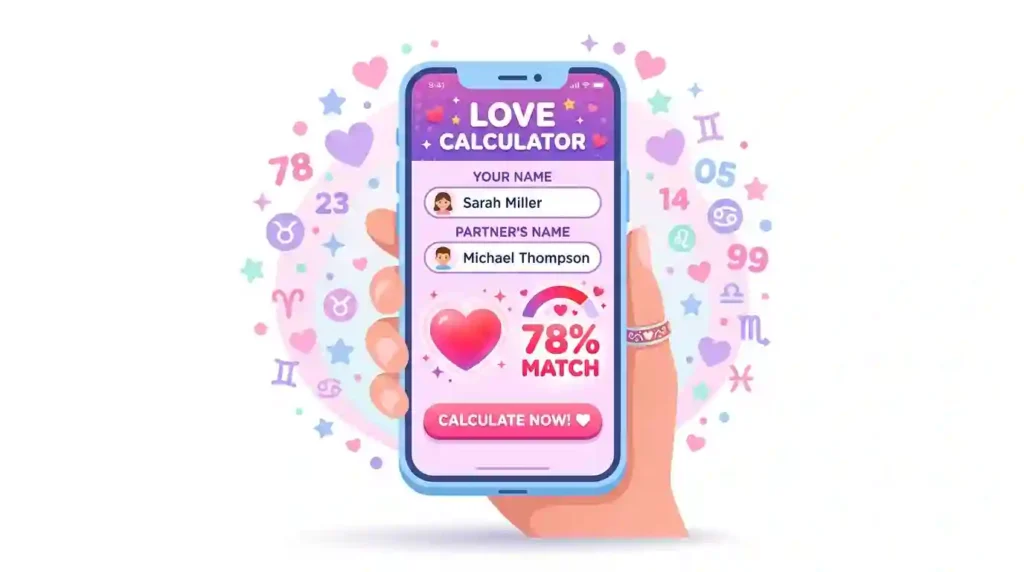
A love calculator is an online tool, app, or widget that takes two names (or sometimes birth dates) and generates a compatibility percentage, supposedly indicating how well two people might get along romantically. These tools are wildly popular on social media, dating blogs, astrology sites, and entertainment platforms because they’re quick, fun, and shareable.
Most love calculators rely on one or a combination of the following methods:
- Numerology-based calculations – assigning numeric values to letters in each name and running them through a formula.
- Random number generation (RNG) – producing a percentage within a set range using programming logic.
- Astrology and zodiac compatibility – factoring in birth dates, sun signs, or moon phases.
- Hybrid algorithms – mixing numerology with randomness for a more “personalized” feel.
While these tools are marketed as compatibility predictors, the overwhelming majority are designed purely for entertainment. This is precisely why Love Calculator Results Change Every Time — the underlying logic isn’t built to produce a fixed, scientific output.
If you want to try one yourself and see how it works in real time, you can test it using this Love Calculator Tool Free, which lets you instantly generate a compatibility score using just two names.
Why Love Calculator Results Change Every Time You Use It
This is the core question most users have, and the answer lies in how these tools are coded behind the scenes.
The Role of Randomization Algorithms
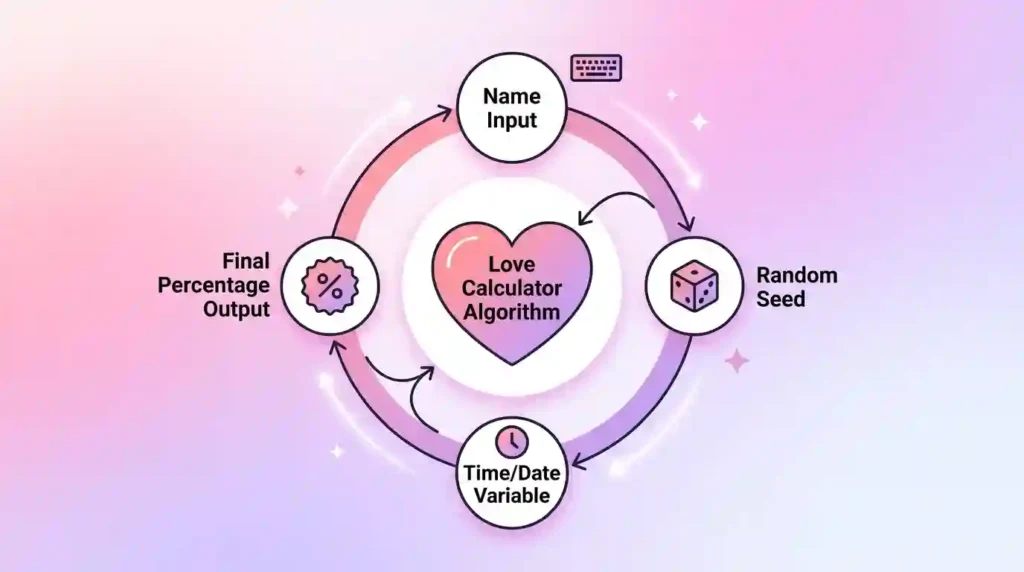
Many love calculators include a random number generator (RNG) as part of their formula. Even if your names remain exactly the same, the RNG introduces a new random seed every time the calculation runs. This means the output can shift by a few percentage points — or sometimes dramatically — between attempts.
Some calculators blend numerology scores (which are fixed, since they’re based on letters) with a random multiplier or offset (which is not fixed). The result is a number that feels personalized but is partially randomized by design.
Name Spelling, Order, and Input Sensitivity
Another reason results vary is simple input sensitivity. If you type “Mike” the first time and “Michael” the second time, or swap the order of the two names, the algorithm reads these as entirely different inputs. Even small differences like:
- Capitalization (e.g., “JOHN” vs. “John”)
- Extra spaces before or after a name
- Middle names or nicknames
- Using a full name vs. a short form
…can all produce different numeric values when the names are converted into numbers for calculation. This is especially true for tools that use letter-to-number mapping systems similar to numerology charts.
Time-Based and Session-Based Seeds
Some advanced or “AI-enhanced” love calculators tie their randomization to the current date, time, or even your browser session ID. This means the exact same names entered on two different days — or even two different browser tabs — can yield different results because the seed value used in the background calculation has changed.
This is similar to how certain horoscope or fortune-telling apps generate a “new” reading daily, even with the same birth information. The goal isn’t consistency — it’s engagement and replayability.
Is There Any Real Science Behind Love Calculators?
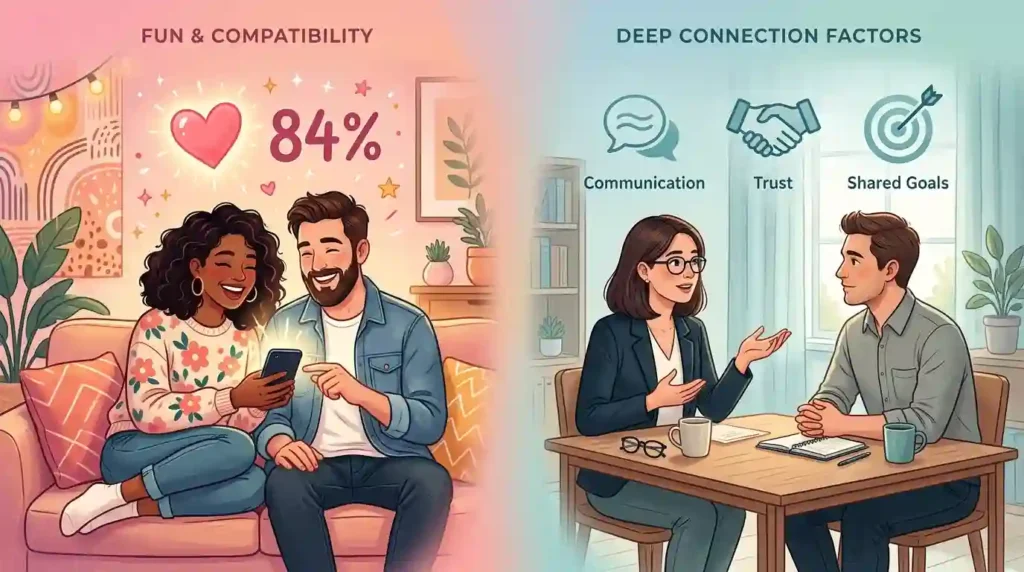
Despite their popularity, love calculators have no grounding in psychological science, relationship research, or peer-reviewed compatibility studies. Real relationship compatibility is studied through fields like attachment theory, communication patterns, shared values, and conflict resolution styles — none of which can be measured by simply typing two names into a text box.
According to relationship research published by the American Psychological Association, long-term relationship success is influenced by factors such as emotional intelligence, communication quality, shared goals, and mutual respect — not numerical name-matching formulas.
That said, love calculators tap into something psychologically real: the human desire for validation, curiosity, and playful self-reflection. They’re entertainment tools, similar to fortune cookies or horoscopes — fun to engage with, but not meant to be taken as relationship advice.
If you’re curious about what makes these tools occasionally generate a perfect score, check out our related guide: What Makes a Love Calculator Give 100% Match, which explores the specific conditions and algorithm quirks that lead to a 100% result.
How to Get Consistent Results from a Love Calculator
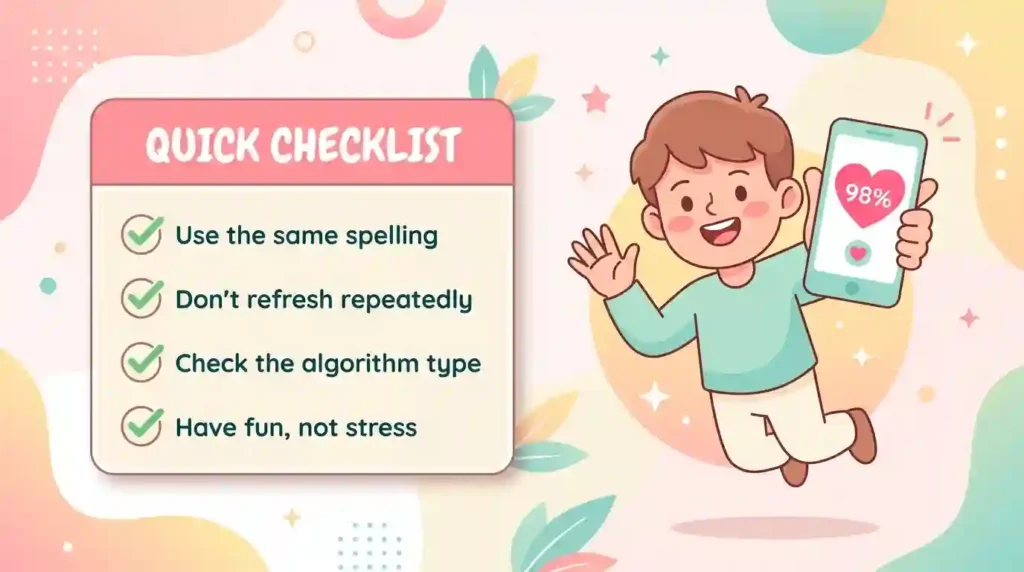
If you want to minimize variation and get the most “stable” result possible, try the following:
Use the Exact Same Input Every Time
Type the names exactly the same way — same spelling, same capitalization, same spacing, and same order. This eliminates one of the biggest variables.
Avoid Refreshing Mid-Calculation
Some tools recalculate their random seed if the page is refreshed or the form is resubmitted too quickly. Let the result fully load before trying again.
Check If the Tool Uses Pure Numerology vs. Hybrid Randomization
Tools based purely on numerology (letter values converted to numbers) tend to produce the same result every time for the same input, since there’s no random component. Hybrid tools — which mix numerology with RNG — will always show variation.
Treat It as a Game, Not a Verdict
Ultimately, the most “consistent” approach is mental: enjoy the result for what it is — a fun, lighthearted activity — rather than searching for a definitive answer about your relationship.
Why People Still Love Using Love Calculators Despite Changing Results
Even knowing that results aren’t scientifically accurate, millions of people continue to use love calculators every day. Why?
- Entertainment value – They’re quick, fun, and shareable on social media.
- Curiosity and novelty – Getting a new percentage each time adds an element of surprise.
- Social bonding – Friends and couples often try them together as a lighthearted activity.
- Nostalgia – Many people remember using similar tools in their teenage years and enjoy revisiting them.
The fact that Love Calculator Results Change Every Time actually adds to the appeal for many users — it keeps the experience fresh and game-like, rather than feeling like a one-time, static result.
Conclusion
If you’ve noticed that your love calculator score keeps shifting between attempts, it’s not a glitch — it’s by design. Whether it’s due to randomization algorithms, sensitivity to name spelling and order, or time-based seed values, these tools are built primarily for entertainment, not precision. While love calculators can be a fun way to spark conversation or add a playful element to your day, real relationship compatibility depends on far deeper factors like communication, trust, and shared values.
So the next time you see a different percentage pop up, take it with a smile — and maybe try the calculator again just for fun.
FAQs
Q1: Why does my love calculator give a different score every time I enter the same names?
Most love calculators use a combination of name-based numerology and random number generation. The random component changes each time the calculation runs, leading to different results even with identical inputs.
Q2: Are love calculator results based on real science?
No. Love calculators are designed for entertainment purposes and are not based on psychological research or relationship science.
Q3: Can I get the exact same result twice?
It’s possible if the tool uses a purely numerology-based formula without any randomization. However, many tools include random elements, so getting an identical result twice isn’t guaranteed.
Q4: Does the order of names affect the result?
Yes. Many algorithms calculate values based on the order and combination of letters, so swapping the order of names can produce a different percentage.
Q5: Should I take love calculator results seriously?
No — these tools are meant for fun and casual entertainment. Real relationship compatibility depends on communication, trust, shared values, and emotional connection, not an online percentage.