
Summary
Ever typed in two names, hit “calculate,” and stared at the screen waiting for that magic number? A Love Calculator Give 100% Match result feels like a tiny jackpot — equal parts thrilling and suspicious. But what actually goes on behind that percentage? In this article, we’ll break down the algorithms, numerology, name compatibility theories, and psychological tricks that combine to produce a perfect score, while also being honest about how seriously you should (or shouldn’t) take it.
Table of Contents
- Introduction: The Allure of the Perfect Score
- How Does a Love Calculator Give 100% Match?
- The Science (and Pseudoscience) Behind Compatibility Algorithms
- Numerology and Letter-Based Matching Explained
- Astrology, Zodiac Signs, and Birth Date Calculations
- Psychological Factors That Influence Perceived Accuracy
- Can You “Trick” a Love Calculator Into Giving 100%?
- Should You Trust a 100% Love Match Result?
- How to Use a Love Calculator the Right Way
- Conclusion
- FAQs
Introduction: The Allure of the Perfect Score
There’s something irresistible about seeing the number 100% appear next to your name and your crush’s name. It feels validating, almost like the universe just gave you a thumbs-up. Online relationship tools have exploded in popularity precisely because they tap into this emotional curiosity — we want confirmation, even if we know deep down it’s “just for fun.”
But here’s the real question that brings most curious users to search engines: what makes a love calculator give 100% match, and is that number actually meaningful? To answer that, we need to peek under the hood of how these tools are built, what data they use, and why two different calculators might give you wildly different results for the exact same pair of names.
How Does a Love Calculator Give 100% Match?
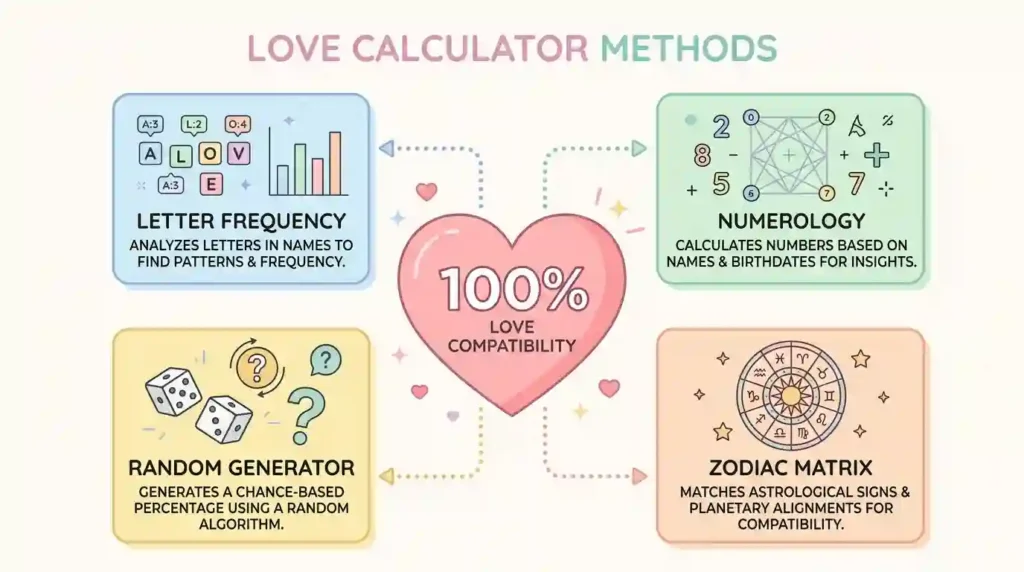
At its core, a love calculator is a piece of software that takes two inputs — usually names, birthdates, or both — and runs them through a formula to produce a percentage. The way a love calculator give 100% match result is generated depends entirely on the methodology the tool uses. Broadly, there are four common approaches:
1. Letter-Frequency Algorithms
Many calculators count how many letters from the word “LOVE” appear in both names, then run those counts through a repeating subtraction or addition formula until a two-digit number emerges. If the math happens to land exactly on 100 (or the formula caps results and rounds certain combinations up), you get a perfect score.
2. Numerology-Based Systems
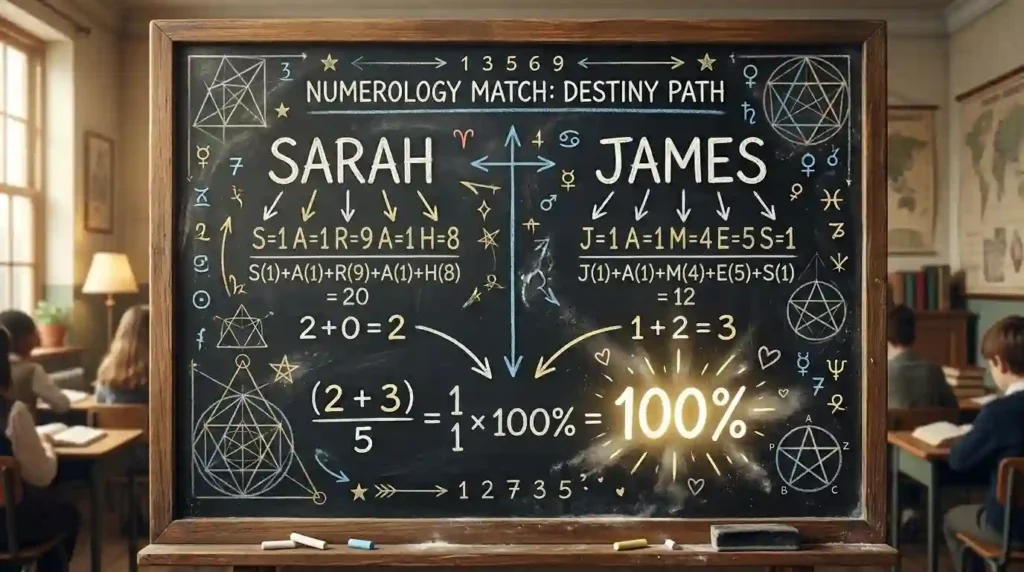
Some tools convert each letter of a name into a numeric value (A=1, B=2, and so on), sum them up, and reduce them to a single digit or master number. Certain name combinations naturally produce matching numerology numbers — and when both names reduce to compatible or identical numbers, the tool may interpret that as a 100% alignment.
3. Random Number Generators with Weighted Bias
Let’s be honest — a large portion of “fun” love calculators online are essentially glorified random number generators. Some are coded with a bias toward higher numbers (because users enjoy seeing good results and are more likely to share them), which means a 100% match is sometimes simply a programmed possibility rather than a calculated outcome.
4. Compatibility Matrix Based on Zodiac or Birth Data
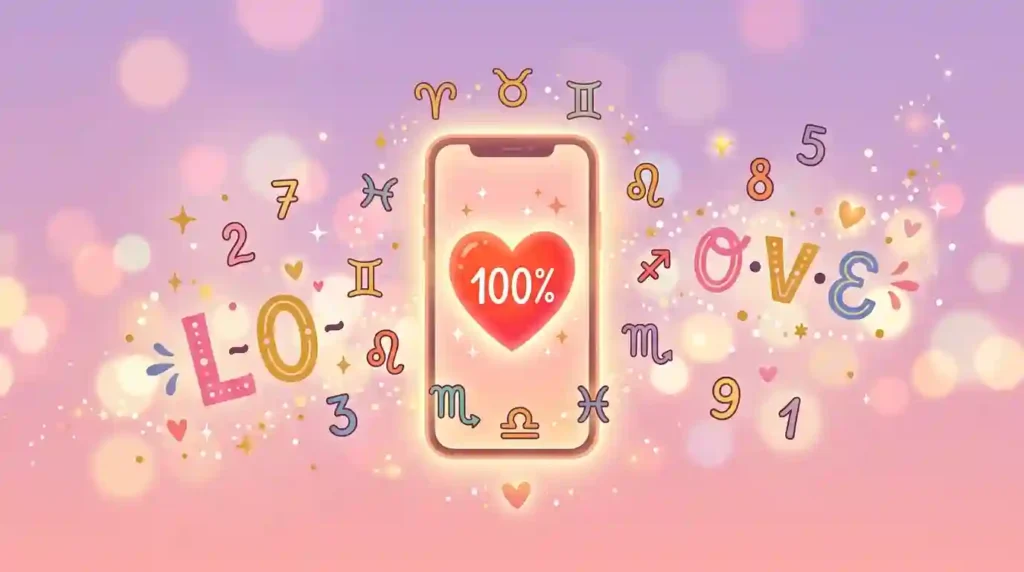
More sophisticated calculators cross-reference astrological compatibility charts, element pairings (fire, water, air, earth), and ruling planets. Certain zodiac pairings — like two Water signs or complementary Earth-Air combinations — are traditionally considered highly compatible, and a calculator using this method might assign these pairings a near-perfect or perfect score.
The Science (and Pseudoscience) Behind Compatibility Algorithms
It’s important to separate entertainment tools from genuine relationship science. Real compatibility research — conducted by psychologists and relationship counselors — looks at factors like communication styles, attachment patterns, shared values, conflict resolution skills, and emotional intelligence. None of these can be captured by typing two names into a box.
That said, the psychology of why we enjoy these tools is well documented. The Barnum effect — where vague, general statements feel personally meaningful — plays a huge role. When a calculator tells you “you two share a deep emotional connection,” it feels specific, even though it’s a generic statement that could apply to almost any pair.
For readers who want a deeper, evidence-based look at whether these tools hold up in real relationships, we’ve covered this extensively in our guide on Is Love Calculator Accurate for Real Relationships, which explores the gap between algorithmic fun and genuine relationship compatibility.
Numerology and Letter-Based Matching Explained
How the FLAMES Method Works
One of the oldest name-matching games is FLAMES (Friends, Lovers, Affectionate, Marriage, Enemies, Siblings). It works by removing common letters between two names and counting the remainder, then cycling through the FLAMES letters to land on a result. While FLAMES doesn’t produce a percentage directly, many modern calculators borrowed its structure and adapted it into a 0–100% scale.
Pythagorean Numerology and Name Numbers
In Pythagorean numerology, each letter maps to a digit 1–9. By summing the letters of both names and reducing them to single digits, numerologists claim to reveal compatibility based on “life path” or “destiny number” alignment. Numbers like 1 and 1, or 6 and 6, are often considered harmonious — and a calculator built around this system might reward such matches with a perfect score.
Why Certain Name Pairs Are More Likely to Hit 100%
Because the underlying math is deterministic (the same inputs always produce the same output in a given algorithm), certain name combinations are mathematically destined to produce 100% — regardless of the actual people behind those names. This is one of the clearest pieces of evidence that these results are formula-driven, not fate-driven.
Astrology, Zodiac Signs, and Birth Date Calculations
Element-Based Compatibility
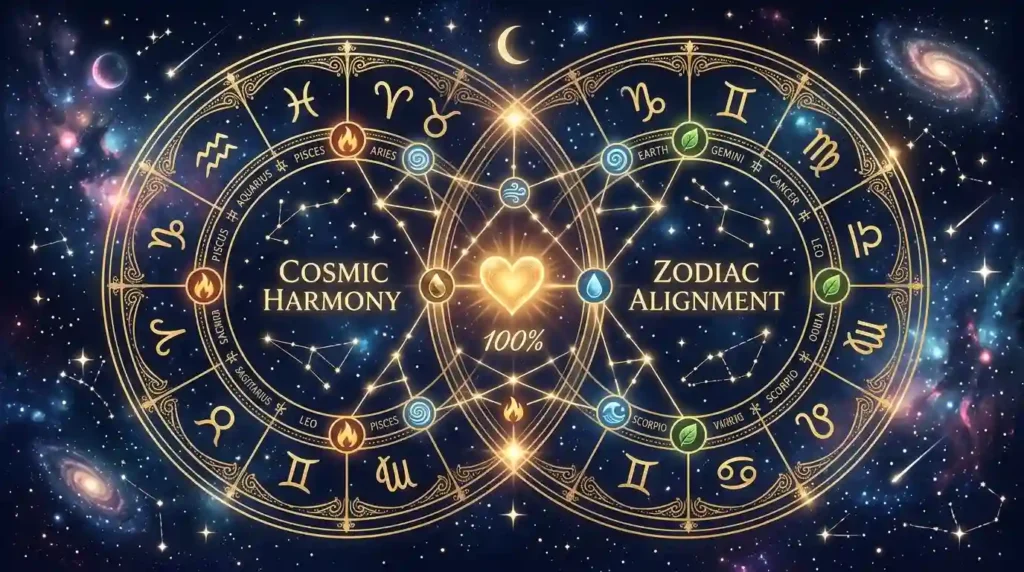
Astrology divides the zodiac into four elements: Fire (Aries, Leo, Sagittarius), Earth (Taurus, Virgo, Capricorn), Air (Gemini, Libra, Aquarius), and Water (Cancer, Scorpio, Pisces). Same-element or complementary-element pairings (like Fire and Air, or Earth and Water) are traditionally seen as highly compatible — and calculators that incorporate zodiac data may score these pairings close to or at 100%.
Sun Sign vs. Full Birth Chart
It’s worth noting that most online calculators only use sun signs (based on birth month/day), which is a massive oversimplification of astrology. A full natal chart compatibility reading — known as synastry — considers moon signs, rising signs, Venus and Mars placements, and dozens of other factors. A simple online tool can never replicate this depth, which is why a 100% sun-sign match doesn’t carry the weight a professional astrological reading might.
For a comprehensive overview of how astrological compatibility is studied academically, resources like American Psychological Association offer research-backed insights into relationship compatibility factors that go far beyond star signs — useful context if you want a more grounded perspective alongside the fun stuff.
Psychological Factors That Influence Perceived Accuracy
Confirmation Bias
If you already like someone, a high match percentage feels like confirmation of something you already believed. If the score is low, you might dismiss the tool as “inaccurate” — but rarely do people question a high score with the same skepticism.
The Novelty and Shareability Factor
Tools that produce 100% results more often tend to be shared more on social media, because people love posting “we got 100%!” screenshots. This creates a feedback loop where calculators are sometimes designed (consciously or not) to produce satisfying, shareable results more frequently than statistically “neutral” outcomes would suggest.
Self-Fulfilling Prophecy
Interestingly, some relationship researchers note that believing you’re highly compatible can actually influence behavior — couples who think they’re a “perfect match” may try harder to resolve conflicts, communicate better, and give each other the benefit of the doubt. So even a “fake” 100% might have a small real-world effect, simply through belief and effort.
Can You “Trick” a Love Calculator Into Giving 100%?
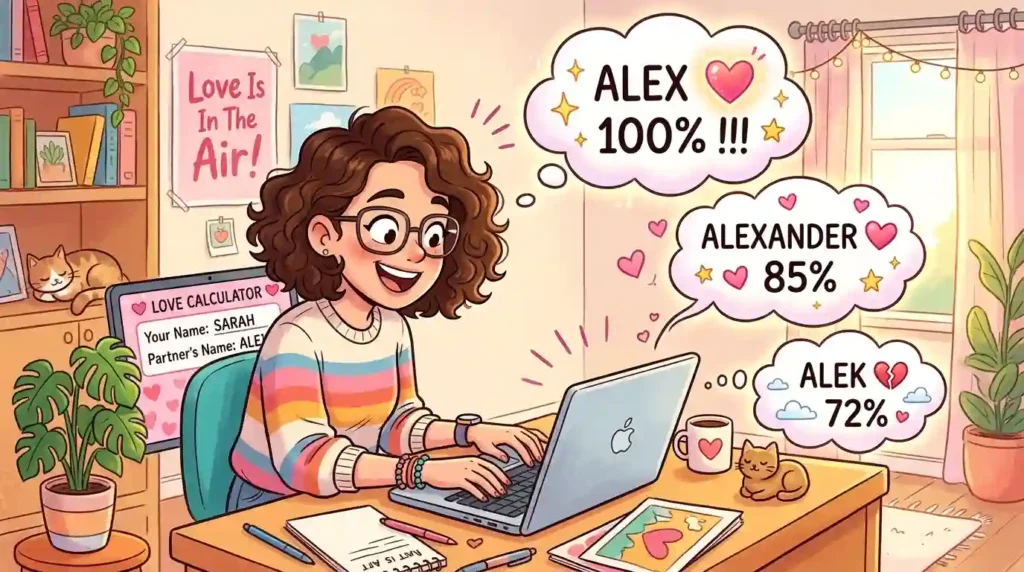
Short answer: sometimes, yes. Since many calculators rely on deterministic formulas based on letters or birthdates, you can experiment with name spelling variations (nicknames, middle names, full legal names) to see how the result changes. Some users discover that adding or removing a middle name shifts the score from 72% to 100% instantly — which is a great practical demonstration of how formula-based these tools really are.
This isn’t “cheating” exactly — it’s just understanding that the tool is a fun mathematical game, not a verified compatibility test.
Should You Trust a 100% Love Match Result?
Here’s the honest, balanced answer: treat it as entertainment, not evidence. A perfect score can be a fun conversation starter, a cute thing to send to a partner, or a lighthearted icebreaker on a first date. It should never be the basis for major relationship decisions, nor should a low score be a reason to doubt a healthy relationship.
Real compatibility is built on shared values, mutual respect, effective communication, emotional support, and aligned life goals — things no algorithm can measure from two names alone.
How to Use a Love Calculator the Right Way
- Use it for fun, not for fate. Treat the result the same way you’d treat a fortune cookie message — lighthearted, not literal.
- Try it with friends and family too. Testing the calculator on platonic relationships (like your best friend or sibling) can reveal how the algorithm behaves and help you calibrate expectations.
- Pair it with real conversation. Use a high or low score as a playful way to start talking about what actually matters in your relationship.
- Don’t overanalyze name variations. If you’re curious how the score changes, experiment — but don’t let a number override your real feelings.
If you’d like to try this out for yourself, you can test different name combinations using our Love Calculator tool, which uses a fun, name-based algorithm to generate instant compatibility percentages.

Conclusion
So, what makes a Love Calculator Give 100% Match? In most cases, it boils down to math — letter counts, numerology reductions, zodiac element pairings, or simply a programmed possibility within a random generator. While the science of real compatibility is far more nuanced and rooted in psychology and communication, there’s nothing wrong with enjoying these tools for what they are: a fun, nostalgic, slightly magical piece of internet culture. Whether you get 100%, 72%, or 45%, remember that the real “calculator” for love is the effort, respect, and communication two people put into their relationship every single day.
FAQs
Q1: Is a 100% love match result real or fake?
It’s “real” in the sense that the algorithm genuinely calculated it based on your inputs, but it’s not a scientifically validated measure of actual relationship compatibility. It’s entertainment-based, not evidence-based.
Q2: Can the same names give different results on different calculators?
Yes. Since each calculator uses its own formula — whether letter-based, numerology-based, or zodiac-based — the same two names can produce completely different percentages across different tools.
Q3: Does spelling or nickname variation affect the result?
Absolutely. Because most calculators work letter-by-letter, using a nickname, middle name, or full legal name can change the calculation significantly, sometimes shifting a result from a low percentage to 100%.
Q4: Should I worry if my partner and I don’t get 100%?
Not at all. Compatibility percentages from online tools have no bearing on real relationship health. Communication, trust, and shared values matter far more than any algorithm-generated number.
Q5: Are love calculators based on astrology more accurate?
They’re more elaborate, since they incorporate zodiac elements and traditional compatibility charts, but “more elaborate” doesn’t mean “more accurate.” Even professional astrology requires full birth charts (synastry) for meaningful analysis — something a simple online tool can’t replicate.