

Summary
This does he love me quiz helps you look beyond romantic words and evaluate the everyday behaviors that may reveal genuine love. By answering honestly, you can assess his consistency, communication, emotional support, respect, effort, affection, and interest in a long-term future. No online relationship quiz can read another person’s mind, but this love test can help you notice meaningful patterns, recognize mixed signals, and prepare for a direct conversation about your relationship.
Table of Contents
- Why It Can Be Difficult to Know If He Loves You
- Does He Love Me Quiz: Answer 15 Questions
- How to Interpret Your Does He Love Me Quiz Score
- Genuine Signs He May Be in Love With You
- Words, Actions, and Different Love Languages
- Mixed Signals and Red Flags
- What to Do After Taking the Love Test
- Conclusion
- Frequently Asked Questions
Why It Can Be Difficult to Know If He Loves You
You may care deeply about a man and still feel uncertain about his partner feelings. He may be warm and attentive in person but slow to answer a text message. He may use affectionate words yet avoid conversations about commitment. Perhaps he treats you with deep affection one week and becomes emotionally distant the next.
These mixed signals naturally create confusion. When unspoken feelings replace honest communication, it is easy to analyze every gesture, response time, compliment, and change in demeanor. You may wonder whether his behavior reflects genuine love, romantic interest, simple friendliness, physical attraction, or a relationship that is convenient for him.
Your own emotions can make the situation harder to read. Relationship anxiety may cause you to interpret a busy afternoon as rejection. Loneliness may make occasional attention feel like an emotional connection. Powerful chemistry can also encourage you to focus on the moments that support your hopes while overlooking an unhealthy relationship pattern.
The clearest affection signal is rarely one dramatic declaration. True love is more often visible through consistent action: how he treats you during ordinary days, responds to your needs, handles conflict, respects your autonomy, and follows through on promises.
If you are also uncertain about your own feelings, the Do I Love Him or Her quiz can help you examine your side of the emotional bond.
Does He Love Me Quiz: Answer 15 Questions
For this is he in love with me quiz, think about his usual everyday behavior rather than one unusually good or bad moment. Choose the answer that most accurately describes your romantic relationship.
How to Score the Love Test
Give yourself:
- 3 points for every A answer
- 2 points for every B answer
- 1 point for every C answer
- 0 points for every D answer
1. Does he make consistent time for you?
A. Yes, he regularly initiates quality time and keeps his plans
B. Usually, although work or other responsibilities sometimes interfere
C. Only when it is convenient for him
D. Rarely, and I am almost always responsible for contact initiation
2. How does he respond when you are upset or stressed?
A. He listens, shows concern, and offers appropriate emotional support
B. He tries to comfort me, even if he does not always know what to say
C. He changes the subject or appears uncomfortable
D. He dismisses my feelings, insults me, or makes the situation worse
3. Do his words and actions match?
A. Yes, his everyday behavior consistently supports what he says
B. Most of the time, with occasional lapses
C. He makes loving promises but often fails to follow through
D. His actions repeatedly contradict his words
4. Does he remember details that matter to you?
A. He remembers important dates, preferences, stories, and concerns
B. He remembers many things but occasionally forgets
C. He notices only details that directly affect him
D. He rarely pays attention to what I share
5. How does he handle an argument?
A. He listens, takes responsibility, and works toward relationship repair
B. He may become defensive but can return and talk calmly
C. He avoids every difficult conversation or gives insincere apologies
D. He uses threats, humiliation, pressure, or intimidation
6. Does he respect your boundaries?
A. Yes, he respects my decisions, privacy, time, body, and independence
B. Usually, although we sometimes need to clarify expectations
C. He argues with boundaries or treats them as personal rejection
D. He ignores boundaries or tries to control my choices
7. Is he emotionally open with you?
A. He shares his thoughts, fears, hopes, and vulnerabilities
B. He gradually opens up when he feels safe
C. He discusses facts but avoids emotional openness
D. He refuses meaningful communication or punishes vulnerability
8. Does he treat you as a priority?
A. His decisions regularly show that the relationship matters
B. He balances me fairly with work, family, friends, and personal needs
C. I often feel like an option rather than a partner
D. He contacts me only when he wants attention, favors, or physical closeness
9. Is he happy about your achievements?
A. He celebrates my success and supports my personal goals
B. He is encouraging, although he may not always express excitement
C. He redirects attention toward himself
D. He becomes jealous, competitive, or tries to reduce my confidence
10. Has he included you in his life?
A. He has made a natural friend introduction or family introduction
B. He has introduced me to some important people
C. He keeps most areas of his life separate without explaining why
D. He hides the relationship or denies it publicly
11. Does he discuss a future with you?
A. Yes, we talk realistically about future planning and shared goals
B. He sees potential but wants the relationship to develop naturally
C. He makes vague romantic promises without practical details
D. He avoids every conversation about relationship intentions
12. How dependable is he?
A. He is reliable and communicates when circumstances change
B. He is generally dependable but occasionally disorganized
C. His effort is unpredictable
D. I cannot trust him to keep promises or show up when needed
13. How does his nonverbal communication feel?
A. His eye contact, body language, touch, and attention feel warm and engaged
B. He is affectionate but naturally reserved
C. His gestures feel romantic only when he wants something
D. His demeanor is regularly cold, contemptuous, or intimidating
14. Does he make reasonable sacrifices for the relationship?
A. Yes, both of us compromise without losing our identities
B. He makes an effort when the need is clearly explained
C. I carry most of the emotional labor
D. He expects sacrifice from me while refusing to compromise himself
15. How do you usually feel in the relationship?
A. Secure, respected, valued, and emotionally connected
B. Mostly happy, with a few concerns we can discuss
C. Frequently confused, anxious, or unsure where I stand
D. Lonely, frightened, controlled, or emotionally exhausted
How to Interpret Your Does He Love Me Quiz Score
Add the points from all 15 answers. The highest possible love score is 45.
36–45 Points: Strong Signs of Genuine Love
Your answers suggest that his caring behavior is supported by consistency, trust, emotional engagement, and respect. He may show genuine care by listening closely, remembering details, offering support, respecting boundaries, and treating the relationship as a meaningful priority.
A high score does not mean your relationship is perfect. Healthy partners still misunderstand each other and experience conflict. The important signs are accountability, dependability, an honest apology, and a shared willingness to repair the connection.
26–35 Points: Affection With Room to Grow
There are likely meaningful signs of mutual interest and emotional connection, but certain parts of the relationship may still be developing. Perhaps he cares about you but struggles with emotional openness. Maybe his intentions appear sincere, yet future planning or communication remains unclear.
Discuss the areas that received lower scores. A calm conversation can reveal whether a concern comes from a correctable difference in love language or a more serious mismatch in effort and commitment.
16–25 Points: Mixed Signals or Unequal Effort
Your result suggests inconsistency. There may be romantic interest, attraction, or affection, but you may not be receiving the reliability and clarity needed for a secure relationship.
Pay attention to the gap between words and actions. An affectionate message, thoughtful gift, or passionate evening cannot compensate for repeated disrespect, disappearing, dishonesty, or a refusal to define relationship intentions. Patterns over time matter more than isolated romantic moments.
0–15 Points: Love May Not Be Showing Up in a Healthy Way
Your answers indicate limited emotional support, weak dependability, or potentially serious red flags. This does not prove that he has no feelings for you, but feelings alone do not create relationship health.
If fear, coercion, intimidation, control, or repeated boundary violations affected your answers, prioritize your safety. Speak with someone you trust or seek professional advice from an appropriate support service.
This relationship assessment is designed for self-reflection. It is not a psychological diagnosis, and a quiz result should never replace your direct experience or personal safety judgment.
Genuine Signs He May Be in Love With You
A love test can organize your observations, but his repeated behavior offers the strongest evidence. Look for several signs working together.
He Shows Consistent Effort
Consistency means he stays engaged after the first excitement fades. He calls when he says he will, makes time for you, and communicates instead of disappearing. His level of care does not change dramatically depending on what he wants.
Real effort does not require constant texting. A healthy response time depends on work, family obligations, communication preferences, and the stage of the relationship. What matters is whether his communication feels reasonably dependable.
He Listens and Remembers
Active listening is an important sign of emotional engagement. He pays attention instead of waiting for his turn to speak. Remembered details—your upcoming appointment, favorite snack, family concern, or important goal—show that your inner world matters to him.
Memory is not a perfect measure of love, and some caring people are naturally forgetful. Look at the wider pattern: does he make an effort to understand you and respond to what you communicate?
He Makes You Part of His Real Life
A man who sees a long-term future may gradually integrate you into his life. He may introduce you to friends, invite you to family events, or include you in plans. These steps suggest that the romantic relationship is not limited to private dates.
The timing will vary. A family introduction after two weeks may be unrealistic, while secrecy after a long, supposedly exclusive relationship may deserve a direct conversation.
He Supports Your Happiness and Success
Genuine love is not threatened by your growth. A caring partner celebrates your achievements, supports your ambitions, and wants you to maintain meaningful interests outside the relationship.
Protectiveness can occasionally feel romantic, but healthy concern respects autonomy. Jealousy, monitoring, or restricting your opportunities is not proof of deep affection.
He Is Emotionally Vulnerable
Emotional openness can show that he trusts you. He may discuss his fears, disappointments, past experiences, and hopes. Vulnerability does not mean disclosing everything immediately; it means gradually allowing the relationship to become emotionally honest.
He Respects Your Boundaries
Respect is one of the clearest signs of genuine love. He accepts “no,” respects your privacy, and does not pressure you into physical closeness, financial sacrifice, or unwanted commitments.
A boundary is not a punishment. It explains what you need to feel safe and respected. A loving partner may ask questions or express his needs, but he does not treat your autonomy as an obstacle to overcome.
He Repairs the Relationship After Conflict
Every couple experiences disagreement. Relationship health depends less on avoiding every argument and more on what happens afterward.
A loving partner can acknowledge harm, offer a sincere apology, listen to your perspective, and participate in relationship repair. He does not use silence, blame, or affection withdrawal to control you.
The American Psychological Association recommends open communication, maintaining individual interests, and seeking support when necessary as ways to strengthen healthy romantic relationships.
Words, Actions, and Different Love Languages
Some men express love verbally, while others communicate it through behavior. One partner may offer affectionate words and compliments. Another may show care through practical help, quality time, physical touch, or a thoughtful gift.
Differences in love language can cause misunderstanding. You may need verbal reassurance while he assumes that fixing your car demonstrates the same message. Neither expression is automatically wrong, but both partners should learn how the other prefers to give and receive affection.
Love languages should not be used to excuse neglect. “I am not good with words” does not justify refusing every emotional conversation. Likewise, buying gifts does not cancel repeated dishonesty or disrespect.
Ask yourself:
- Does he try to understand what makes me feel loved?
- Can I recognize the ways he naturally shows care?
- Are both of us willing to adjust?
- Do I receive affection without having to beg for basic respect?
- Does his communication become clearer over time?
For a playful comparison of your relationship’s strengths, try the Love Compatibility Calculator or the Relationship Compatibility Calculator. These tools can be useful conversation starters, but they cannot replace observable behavior.
Mixed Signals and Red Flags
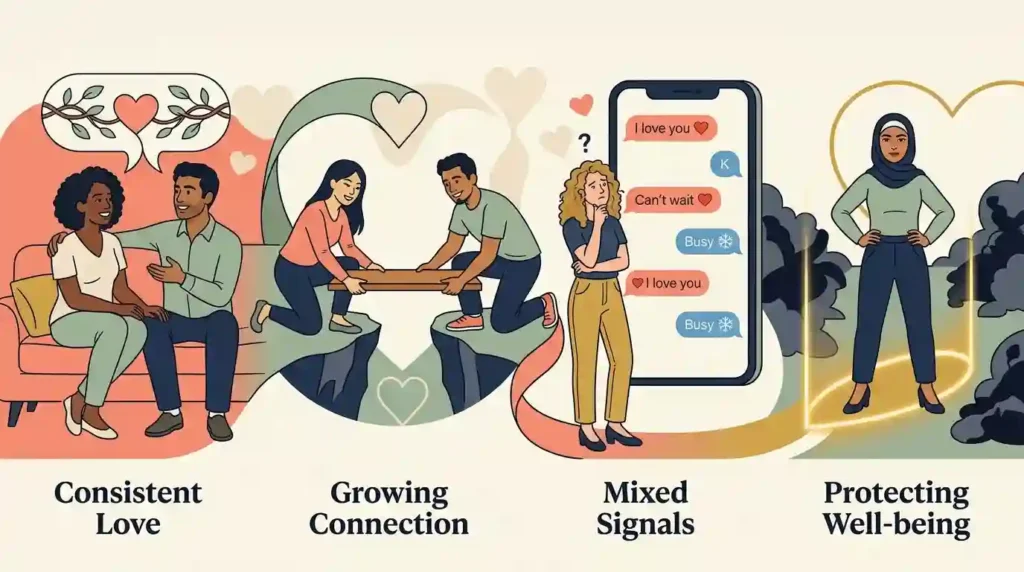
Mixed signals usually occur when a man’s words, actions, and intentions do not align. He may talk about a future but avoid commitment. He may act intensely interested and then disappear. He might express jealousy while refusing exclusivity.
Occasional confusion is normal in a developing relationship. Persistent uncertainty is different. If you continually have to decode his behavior, the relationship may lack honest communication.
Common Mixed Signals
- He sends affectionate messages but rarely makes plans.
- He wants physical closeness without emotional connection.
- He contacts you when lonely but disappears when you need support.
- He calls you important but consistently treats you as an option.
- He makes promises about the future without follow-through.
- He introduces you to friends but keeps the relationship undefined.
- He apologizes repeatedly without changing the behavior.
Serious Relationship Red Flags
A red flag deserves more attention than a low love score. Warning signs include:
- Ignoring physical, emotional, or sexual boundaries
- Monitoring your phone or location
- Isolating you from friends or family
- Belittling your goals or success
- Pressuring you to move, marry, have sex, or share money
- Using jealousy as a reason to control you
- Threatening you during conflict
- Blaming you for his harmful actions
- Making you feel afraid to disagree
- Alternating intense affection with cruelty or punishment
Protectiveness should make you feel supported, not controlled. Sacrifice should be voluntary and reasonably mutual. If your relationship includes pressure or coercion, the central question is not whether he loves you—it is whether you are safe.
A psychologist, licensed counselor, marriage and family therapist, or another qualified mental health professional can help you examine relationship dynamics. A relationship expert or dating coach may offer general guidance, but serious mental health or safety concerns require appropriately trained professional support.
What to Do After Taking the Love Test
Look for a Pattern, Not a Perfect Score
Review your answers and identify the repeated theme. Did you consistently choose options involving respect and reliability? Or did uncertainty, unequal emotional labor, and weak follow-through appear several times?
A pattern is more meaningful than one grand gesture or one disappointing day.
Have a Direct Conversation
The healthiest way to understand his feelings is to ask. Choose a calm moment and speak clearly:
“I care about our relationship, and I want to understand how you see it. What are you hoping we build together?”
Listen to both his answer and his willingness to engage. Relationship clarity requires more than hearing the words you want; it requires understanding whether his plans and behavior support them.
Define What Love Means to You
Consider your expectations regarding commitment, affection, communication, quality time, independence, marriage, and shared goals. You cannot fairly evaluate compatibility without knowing what you need.
If marriage is part of your future planning, the Marriage Compatibility Calculator can introduce lighthearted discussion topics about long-term expectations.
Explore Your Own Feelings
Sometimes “Does he love me?” hides another question: “What do I feel, and what do I want?”
If you are still deciding whether your interest is attraction or something deeper, take the do i have a crush quiz. You can also explore Am I in Love or the do you like your crush quiz.
More reflective activities are available through Love Quizzes & Crush Tests at Love Calculator live.
Give Behavior Time to Become Clear
Early dating can involve excitement, uncertainty, and different communication habits. Avoid making a lifelong conclusion from a single date or text exchange.
At the same time, do not wait indefinitely for basic respect. Time can reveal character, but it does not transform repeated mistreatment into love.
Maintain Your Independence
Continue investing in friendships, interests, health, education, and work. A healthy emotional connection supports both closeness and individuality. You should not have to abandon yourself to prove that you deserve commitment.

Conclusion
A man’s love is best understood through a pattern of consistent care. Affectionate words can be meaningful, but they become more trustworthy when supported by effort, respect, honesty, emotional support, dependability, and follow-through.
Use your result as a self-reflection tool rather than a final verdict. Notice whether he listens, includes you in his life, respects your boundaries, supports your success, and participates in relationship repair. Consider whether his everyday behavior creates happiness, security, and clarity—or confusion, loneliness, and pressure.
You deserve more than occasional attention or impressive promises. Genuine love should allow you to feel valued without sacrificing your autonomy, safety, or sense of self. When uncertainty remains, a calm and honest conversation will usually tell you more than repeated attempts to decode his messages.
Frequently Asked Questions
How do I know if he truly loves me?
Look for consistent effort, respect, emotional support, reliability, honest communication, and actions that match his words.
Is the does he love me test accurate?
It can highlight relationship patterns, but it cannot confirm another person’s feelings. Treat it as self-reflection, not a diagnosis.
What is the biggest sign that he loves me?
Consistency is one of the strongest signs. He reliably shows care during ordinary days, stress, and conflict—not only romantic moments.
Can a man love me without saying it?
Yes, some men express love mainly through actions. However, a healthy relationship should still allow direct communication about feelings and intentions.
Does frequent texting mean he loves me?
Not necessarily. Texting can show interest, but respect, reliability, emotional engagement, and real-world effort provide stronger evidence.
Why does he give me mixed signals?
He may be uncertain, emotionally unavailable, afraid of commitment, or interested without wanting the same relationship. Ask directly instead of guessing.
Is jealousy a sign of love?
Occasional jealousy is a feeling, not proof of love. Controlling, possessive, or intimidating behavior is a red flag.
How long does it take a man to fall in love?
There is no universal timeline. Personality, attachment, experience, and relationship dynamics affect how quickly feelings develop.
Can he love me and still need space?
Yes. Healthy love allows independence and personal time. Space becomes concerning when it is used to avoid responsibility or create insecurity.
Should I ask him if he loves me?
Yes, if the conversation feels safe. Be direct about your feelings, needs, and desired relationship direction.
What if he says he loves me but does not show it?
Focus on the repeated gap between his words and actions. Love without respect, effort, or reliability may not support a healthy relationship.
Can a relationship quiz tell me whether to leave?
No. Consider compatibility, safety, boundaries, well-being, and professional support when making a serious relationship decision.