
Summary
Curious why two names typed into a tiny online box can spit out a percentage that feels strangely accurate? This article breaks down exactly how Name Compatibility Tests Work in Love Calculators, exploring the math, linguistics, numerology, and psychology behind these viral tools. You’ll learn the algorithms used, the role of letter values and numerology charts, why these tests went viral on social media, and how to interpret your results without taking them too literally. Whether you’re testing your crush’s name for fun or genuinely curious about the science (and pseudoscience) behind it, this guide covers everything from FLAMES and numerology-based scoring to letter-matching algorithms and percentage generators.
Table of Contents
- Introduction: The Viral Appeal of Love Calculators
- How Name Compatibility Tests Work in Love Calculators — The Core Mechanics
- The Psychology Behind Name-Based Attraction
- Why Name Compatibility Tests in Love Calculators Work (Or Seem To)
- Step-by-Step: What Happens When You Enter Two Names
- Are These Tests Scientifically Accurate?
- How to Get the Most Out of a Love Calculator
- Conclusion
- FAQs
1. Introduction: The Viral Appeal of Love Calculators
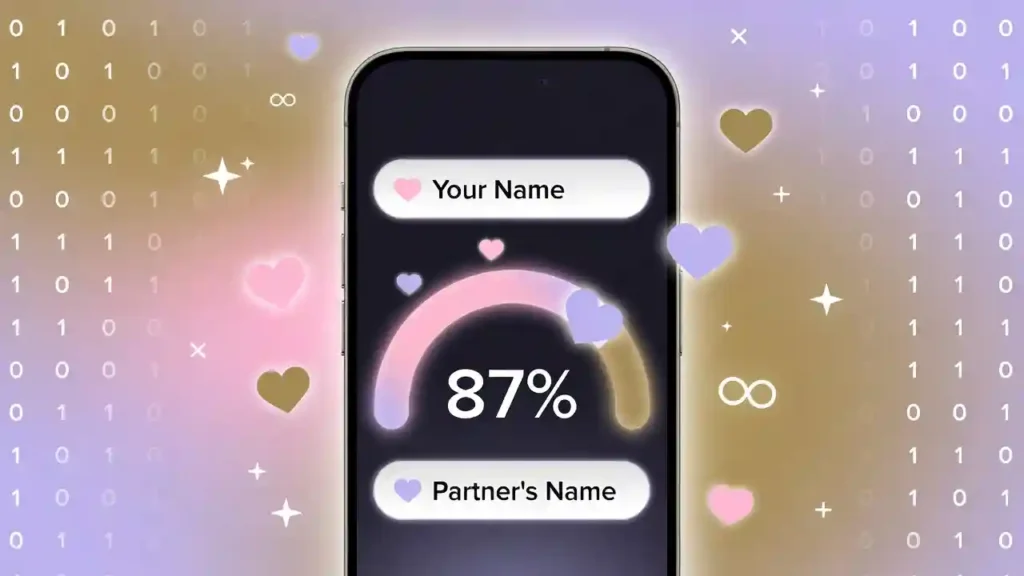
Love calculators have been a staple of internet culture since the early days of the World Wide Web, and they’ve only grown more popular with the rise of social media, TikTok trends, and mobile apps. Millions of people every day type in their name and a crush’s name, hit a button, and wait nervously for a percentage to appear. But behind that simple interface lies a surprisingly structured combination of mathematics, ancient numerology systems, and modern data science.
Understanding the mechanics doesn’t necessarily ruin the fun — in fact, knowing how these systems work can make the experience more engaging, especially if you’re a developer, content creator, or simply someone who loves understanding the “why” behind viral internet phenomena.
2. How Name Compatibility Tests Work in Love Calculators — The Core Mechanics
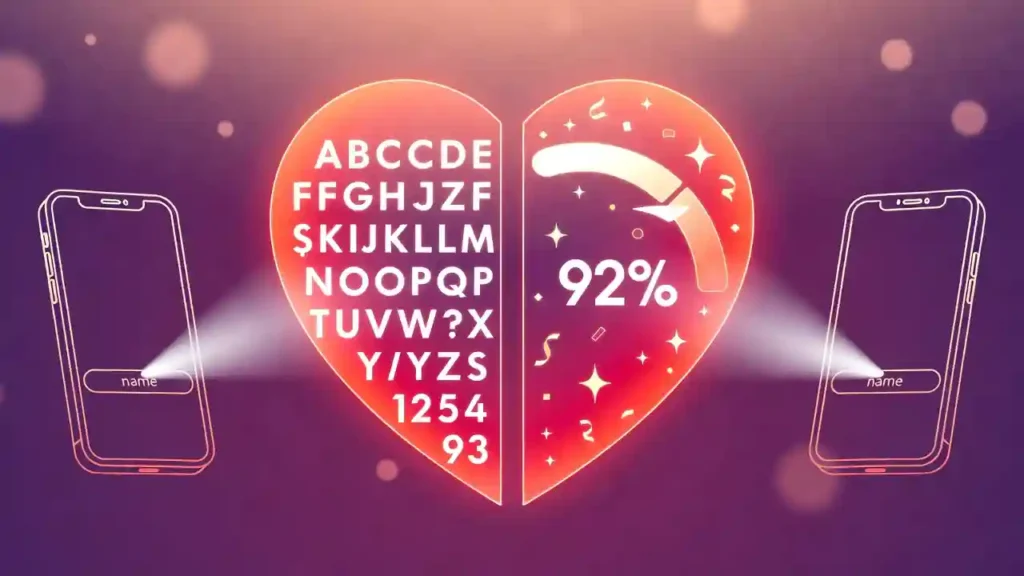
At their foundation, Name Compatibility Tests Work in Love Calculators by converting names into numerical or symbolic data, then applying a formula or algorithm that produces a final score, usually expressed as a percentage. There isn’t just one method — most popular calculators blend several techniques to create a more “personalized” feel.
2.1 Letter-Matching Algorithms
The most common method involves comparing the letters of both names. Here’s a simplified breakdown of how this works:
- Both names are written out, removing spaces and sometimes vowels or repeated letters depending on the algorithm.
- Matching letters between the two names are identified and cancelled out in pairs.
- The remaining letters are counted.
- This remainder is converted into a final compatibility score using a predefined formula or lookup table.
This method is rooted in a classic game many people played as children — the “FLAMES” game — which we’ll explore in more detail shortly.
2.2 Numerology-Based Name Compatibility
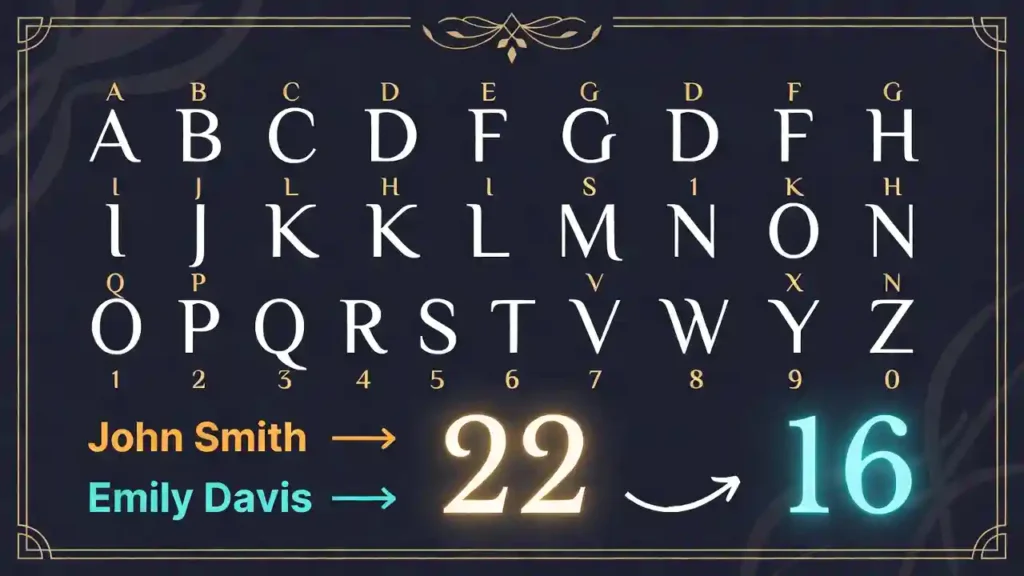
Numerology-based love calculators take a different approach, rooted in ancient numerological systems such as Pythagorean numerology or Chaldean numerology. Here’s how it generally works:
- Each letter in a name is assigned a numerical value (A=1, B=2, C=3, and so on, or based on a specific numerology chart).
- The numbers for each name are summed and then reduced to a single digit (or sometimes a master number like 11, 22, or 33) through a process called digit summing.
- These reduced numbers — often called “Life Path” or “Destiny” numbers — are then compared using a compatibility chart that numerologists have historically used to determine relationship harmony.
For example, if your name reduces to the number 3 and your partner’s name reduces to the number 6, the calculator checks a predefined compatibility matrix to see how well 3 and 6 traditionally “pair” in numerological theory.
2.3 The FLAMES Method Explained
FLAMES is one of the oldest and most beloved name-matching games, and many love calculators are essentially digitized versions of it. The acronym stands for:
- F – Friends
- L – Lovers
- A – Affection
- M – Marriage
- E – Enemies
- S – Siblings
The process works like this:
- Write both names side by side.
- Cross out matching letters one-by-one (each matching letter pair is removed once).
- Count the remaining letters.
- Use that final number to count through the letters F-L-A-M-E-S in a circular pattern, eliminating letters as you go, until only one remains.
- The remaining letter reveals the “relationship category” — Friends, Lovers, Affection, Marriage, Enemies, or Siblings.
Online love calculators automate this entire process instantly, often combining it with a percentage score for added visual appeal.
3. The Psychology Behind Name-Based Attraction
3.1 The Name-Letter Effect
Interestingly, there’s a documented psychological phenomenon called the “name-letter effect,” which suggests people tend to have an unconscious preference for letters found in their own names. While this concept originates from broader research on implicit self-esteem and preference formation, it has been informally linked by enthusiasts to why certain name combinations “feel” more compatible to people. For a deeper academic look at how psychological biases shape preferences, the American Psychological Association offers extensive resources on cognitive bias research.
3.2 Why We Trust Percentage-Based Results
Humans are naturally drawn to quantifiable data — even when that data is arbitrary. A compatibility score of “78%” feels more credible than a vague statement like “you two seem like a good match.” This is part of why love calculators format their output as percentages: it taps into our brain’s preference for measurable, structured information, even when the underlying calculation is essentially randomized or symbolic.
4. Why Name Compatibility Tests in Love Calculators Work (Or Seem To)
4.1 Confirmation Bias and the Barnum Effect
A major reason these tools feel “accurate” is the Barnum Effect — the tendency for people to rate vague, general statements as highly accurate descriptions of themselves. When a love calculator says “You both share strong emotional bonds, but communication may need work,” it’s vague enough to apply to nearly any relationship. Combined with confirmation bias (focusing on results that align with what we already hope or believe), this creates a powerful illusion of personalized accuracy.
4.2 Cultural and Linguistic Influences on Name Perception
Names carry cultural weight. Certain name combinations might “sound” more harmonious due to phonetic rhythm, syllable matching, or cultural familiarity — independent of any algorithm. Love calculators sometimes inadvertently tap into these linguistic patterns, especially when names share similar lengths, vowel sounds, or cultural origins, making the results feel more “natural” even though the underlying math is purely numerical.
5. Step-by-Step: What Happens When You Enter Two Names
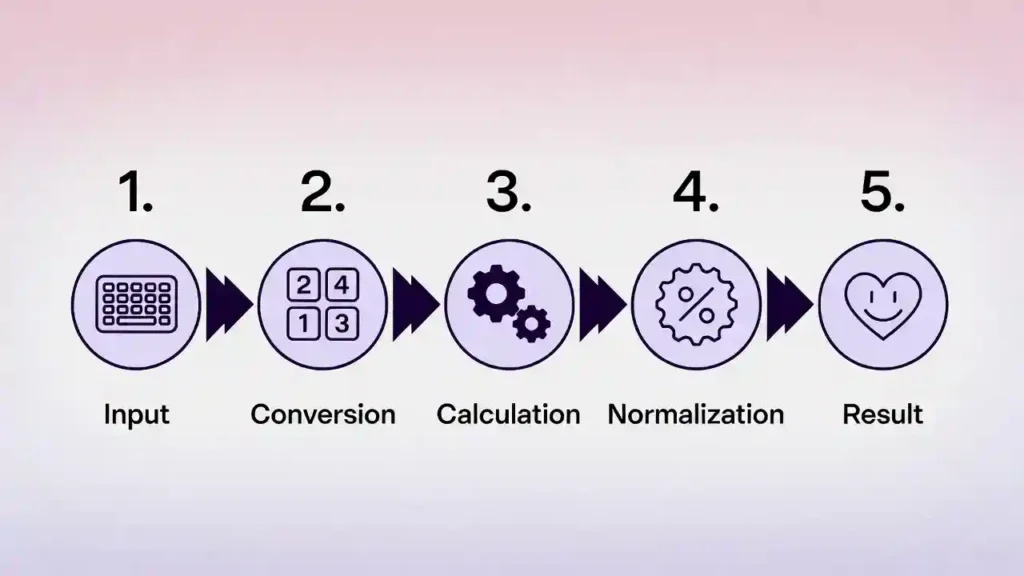
Here’s a simplified walkthrough of what typically happens behind the scenes when you use an online love calculator:
- Input Sanitization – The tool removes spaces, capitalization differences, and special characters from both names.
- Conversion to Numerical Values – Each letter is mapped to a number using a numerology chart or letter-matching algorithm.
- Calculation Engine – The numbers are processed through a formula — this could be digit summing, letter cancellation (FLAMES-style), or a hybrid scoring system.
- Score Normalization – The raw result is converted into a percentage between 0% and 100% (most tools avoid extremes like 0% or 100% to maintain a “balanced” feel).
- Result Display – A message, percentage, and sometimes a relationship category (Friends, Lovers, Soulmates, etc.) is displayed, often paired with fun graphics or animations.
If you want to see this entire process in action, you can try the Calculate Love Tool to enter two names and instantly see how the algorithm generates a compatibility percentage in real time.
6. Are These Tests Scientifically Accurate?
Let’s be transparent: love calculators are designed primarily for entertainment. There is no peer-reviewed scientific evidence that the letters in someone’s name can predict relationship success, emotional compatibility, or long-term happiness. Numerology, while culturally significant and historically rich, is considered a pseudoscience by mainstream psychology and astronomy communities.
However, this doesn’t mean these tools are “useless.” They serve several legitimate purposes:
- Entertainment and social bonding – Sharing results with friends or partners can spark fun conversations.
- Icebreakers – Many people use these tools in early dating stages as a lighthearted way to connect.
- Self-reflection prompts – Some results encourage users to think about communication styles, emotional needs, or relationship values — even if the trigger (a name-based score) isn’t scientifically meaningful.
For a deeper dive into how specific letters and name structures influence these scores, check out our detailed breakdown on how Name Influence Your Love Compatibility Score, which explores letter weight, numerology charts, and real examples.
7. How to Get the Most Out of a Love Calculator
If you’re using these tools — and let’s be honest, most of us have at least once — here are some tips to enjoy them responsibly:
7.1 Treat Results as Entertainment, Not Prophecy
Don’t let a low percentage discourage you from a relationship you genuinely value, and don’t let a high percentage justify ignoring real compatibility factors like communication, shared values, and mutual respect.
7.2 Use It as a Conversation Starter
Many couples and friend groups use love calculators as a fun activity — testing different name spellings (nicknames vs. full names) can produce different results, which can lead to laughter and lighthearted debates.
7.3 Explore the Numerology Behind Your Own Name
If the numerology angle interests you, take time to learn about your own “Life Path Number” or “Destiny Number” — many people find this a fun gateway into broader self-reflection practices, even if approached with healthy skepticism.

8. Conclusion
So, how do Name Compatibility Tests Work in Love Calculators? At their core, they combine simple algorithms — letter matching, numerology-based digit summing, and classic games like FLAMES — with psychological principles like the Barnum Effect and confirmation bias to create results that feel personal and meaningful. While there’s no scientific backing to suggest your name combination determines your romantic destiny, these tools remain a beloved part of internet culture for good reason: they’re fun, shareable, and occasionally spark genuine moments of connection and conversation.
Whether you’re a skeptic who enjoys understanding the mechanics or someone who just wants to have fun testing names with friends, love calculators offer a lighthearted way to engage with the timeless human curiosity about love and connection. Try it yourself, take the results with a grain of salt, and most importantly — enjoy the process.
9. FAQs
Q1: Are love calculator results based on real data? No. Most love calculators use predetermined algorithms based on letter matching or numerology rather than real relationship data or scientific research.
Q2: Why do different love calculators give different results for the same names? Because each tool may use a different algorithm — some rely on FLAMES-style letter cancellation, others use numerology charts, and some use entirely random number generators disguised as formulas.
Q3: Does using a nickname change the compatibility score? Yes, often significantly. Since the algorithms are based on letters and their numerical values, even small spelling changes (like “Mike” vs. “Michael”) can produce different results.
Q4: Can love calculators predict if a relationship will last? No. These tools are designed for entertainment purposes and should not be used as a basis for real relationship decisions.
Q5: What’s the difference between a love calculator and a numerology compatibility reading? A love calculator is typically a quick, automated, entertainment-focused tool, while a numerology compatibility reading is usually a more in-depth analysis performed by someone familiar with numerological traditions, often considering birth dates alongside names.