

Summary
Many people wonder, Name Influence Love Compatibility Score? The simple answer is yes, your name can influence the score shown by a love calculator, but not because your name scientifically controls your relationship future. In most online love compatibility tools, names are used as input data to generate a fun, symbolic, or algorithm-based score. Some tools use letter matching, numerology-style patterns, initials, name length, vowels, consonants, or custom formulas to create a compatibility percentage. However, real love compatibility depends more on communication, trust, emotional maturity, shared values, respect, and how two people treat each other in daily life.
A name compatibility score can be entertaining, interesting, and even a conversation starter, but it should not be treated as a final relationship decision. This article explains how names may affect love calculator scores, why people enjoy name-based compatibility tests, what the score really means, and how to use it in a healthy and fun way.
Table of Content
- What Does a Love Compatibility Score Mean?
- Does Name Influence Love Compatibility Score?
- How Name Influence Love Compatibility Score in Love Calculators
- Why Names Feel So Personal in Romantic Compatibility
- The Psychology Behind Name-Based Love Tests
- Do Names Really Decide Relationship Success?
- Name Compatibility vs Real Relationship Compatibility
- How Love Calculators Use Names to Create a Score
- What a High Love Compatibility Score May Suggest
- What a Low Love Compatibility Score Really Means
- Should You Trust a Name Compatibility Test?
- How to Use Love Compatibility Scores in a Healthy Way
- Conclusion
- FAQs
What Does a Love Compatibility Score Mean?
A love compatibility score is usually a percentage or rating that shows how well two people may match according to a specific love calculator. For example, a calculator may show 85%, 72%, or 96% after you enter two names. This number is often called a love score, relationship score, romance score, couple compatibility score, or name compatibility result.
The important thing to understand is that the score is not a scientific relationship diagnosis. It does not know your full personality, your history, your communication style, your emotional needs, or your future choices. Instead, the score is based on the method used by the specific tool.
Some love calculators use names only. Others may include birthdays, zodiac signs, gender, personality questions, or relationship preferences. But when a calculator asks only for two names, the result is mainly generated through name-based patterns.
That means your name can influence the final number because the tool uses your name as the main input. If you change the spelling, add a nickname, use a full name instead of a short name, or reverse the order of names, the score may change.
For example:
| Input Style | Possible Result Difference |
| Alex + Maria | One score |
| Alexander + Maria | Different score |
| Alex + Marie | Different score |
| A. Alex + M. Maria | Different score |
| Nickname + Full Name | Different score |
This happens because the tool reads the letters, length, sequence, or symbolic value of the names differently.
Does Name Influence Love Compatibility Score?
Yes, a name can influence a love compatibility score when the calculator is designed to use names as part of its formula. However, this influence is usually technical or symbolic, not scientific.
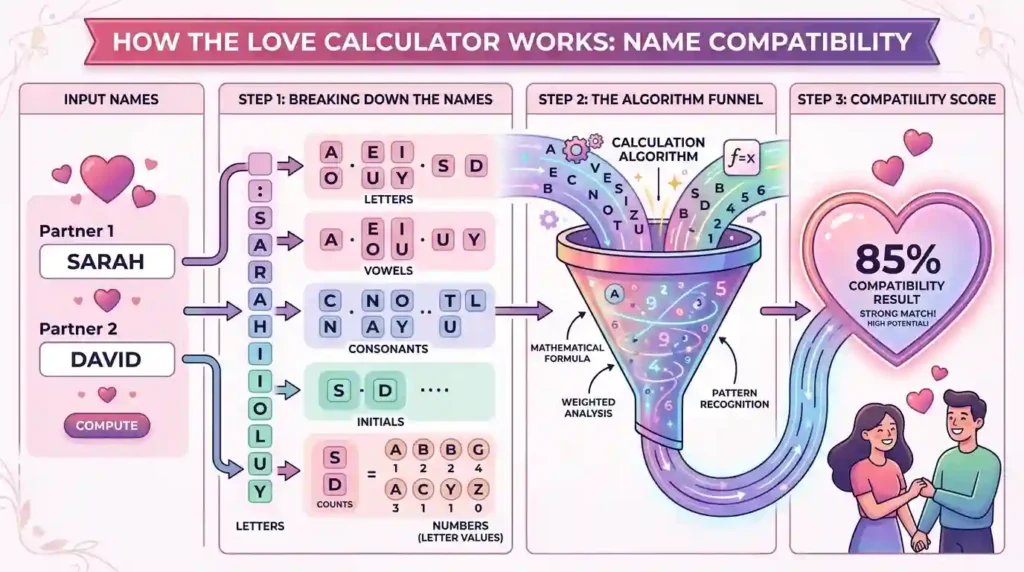
In simple words, your name influences the score because the calculator reads your name as data. It may count letters, compare vowels, match initials, calculate numbers from alphabets, or apply a pre-built formula. The final love score is then created from that process.
But your name does not control your real romantic future. A person named “Sarah” is not automatically more compatible with “Daniel” just because a calculator gives them a high score. In the same way, a low score between two names does not mean the relationship will fail.
A name-based compatibility score is better understood as a fun digital prediction, not a serious relationship judgment.
For example, if a love calculator gives two names a 93% match, it may simply mean the names work well inside that tool’s algorithm. It does not mean the couple will always communicate well, solve problems maturely, or share the same life goals.
Real compatibility is built through behavior. A healthy relationship depends on emotional safety, honesty, respect, shared effort, and the ability to understand each other. The American Psychological Association defines a relationship as an ongoing interpersonal connection where people can influence each other’s thoughts, feelings, and actions. You can read more from the APA Dictionary of Psychology.
So, names may influence the love calculator result, but actions influence real love.
How Name Influence Love Compatibility Score in Love Calculators
The reason people ask how names affect love calculator results is simple: the score often changes when the name changes. This makes users wonder whether the calculator is reading something meaningful from the name.
In many love calculators, the name is the core input. The system may use a custom formula to turn letters into numbers. Then it compares both names and produces a love percentage.
Here are some common ways names may influence the result.
1. Letter Matching
Some calculators check how many letters both names share. If two names have similar letters, the tool may generate a higher score.
For example:
- Emma and Ethan share the letter “E”
- Daniel and Danielle share many similar letters
- Anna and Aaron share repeated “A” letters
This type of matching creates the feeling that the names are connected. It is simple, but it can make the result feel personal.
2. Name Length
Some love compatibility tools compare the length of both names. If the names are similar in length, the score may increase. If one name is very short and the other is very long, the formula may produce a different result.
For example:
- Mia + Leo
- Isabella + Alexander
- Ava + Christopher
The tool may treat each pair differently because the number of letters changes the calculation.
3. Vowels and Consonants
Names are made of vowels and consonants. Some calculators use vowel-consonant balance to create a compatibility result.
For example, a name with many vowels may be treated differently from a name with mostly consonants. This does not reveal true personality, but it gives the calculator more data to process.
4. Alphabet Position
Some tools convert letters into numbers based on their alphabet position.
For example:
- A = 1
- B = 2
- C = 3
- D = 4
Then the numbers from both names are added, compared, reduced, or processed through a formula. This is similar to numerology-style scoring, although every website may use a different method.
5. Initials
Initials can also influence some name compatibility results. The first letters of both names may be compared to create a quick match score.
For example:
- A + A may score differently than A + Z
- R + S may score differently than M + N
Again, this is part of the calculator’s design, not proof of emotional compatibility.
6. Full Name vs Nickname
A full name may produce a different result than a nickname because the letters are different.
For example:
- William may score differently than Will
- Elizabeth may score differently than Liz
- Michael may score differently than Mike
- Katherine may score differently than Kate
This is why users sometimes try different versions of their names to see which result feels more accurate or fun.
Why Names Feel So Personal in Romantic Compatibility
Names are deeply personal. Your name is often one of the first things people learn about you. It is connected to your identity, culture, family, personality, memories, and emotional experiences.
That is one reason name compatibility tests feel exciting. When you type your name with someone else’s name, it feels like the calculator is checking something private and meaningful.
A name can carry emotional weight. Seeing your name next to your crush’s name can create a small moment of curiosity. It may make you wonder:
- Do we sound good together?
- Do our names look nice together?
- Could this person be my perfect match?
- Is there a hidden connection between us?
- What if this score says something real?
This is why name-based love calculators remain popular. They combine curiosity, romance, identity, entertainment, and hope in one simple activity.
People do not always use love calculators because they believe them completely. Many people use them because they are fun, quick, and emotionally engaging. It feels exciting to see a number attached to a romantic possibility.
Names also create a sense of personalization. A generic relationship quiz may feel broad, but a name compatibility test feels specific because it uses your actual name and the name of the person you like.
That personal touch makes the result more memorable.
The Psychology Behind Name-Based Love Tests
Name compatibility tests work well because they connect with human curiosity. People naturally want signs, patterns, and emotional confirmation, especially in romantic situations.
When someone likes another person, they often look for small clues. A text message, a smile, a shared interest, a similar birthday, or even a matching name initial can feel meaningful. A love compatibility score gives that curiosity a clear number.
Pattern Seeking
Humans are pattern-seeking by nature. We like to connect dots and find meaning in small details. If two names share letters or sound good together, the mind may interpret that as a romantic sign.
This does not mean the sign is scientifically true. It simply means the brain enjoys finding connections.
Emotional Validation
A high love score can feel validating. If someone already likes a person, a 90% score may feel like encouragement. It can make the user smile, share the result, or start a conversation.
A low score may create surprise, but many users still treat it lightly because they know the tool is mainly for fun.
Curiosity and Entertainment
Love calculators are easy to use. You do not need to answer long personality questions. You only enter two names and get an instant result. This makes the experience quick, playful, and shareable.
That is why name compatibility calculators often become popular among friends, couples, teenagers, social media users, and people who enjoy romantic quizzes.
Do Names Really Decide Relationship Success?
No, names do not decide relationship success. Your name may affect a love calculator score, but it does not determine whether your relationship will be healthy, happy, or long-lasting.
Real relationship success depends on deeper factors, such as:
- Communication
- Trust
- Respect
- Emotional maturity
- Shared values
- Conflict resolution
- Commitment
- Honesty
- Kindness
- Personal boundaries
- Mutual support
- Life goals
- Physical and emotional attraction
A couple with a low name compatibility score can still build a strong relationship if they communicate well and respect each other. A couple with a high score can still struggle if they lack trust, patience, or emotional understanding.
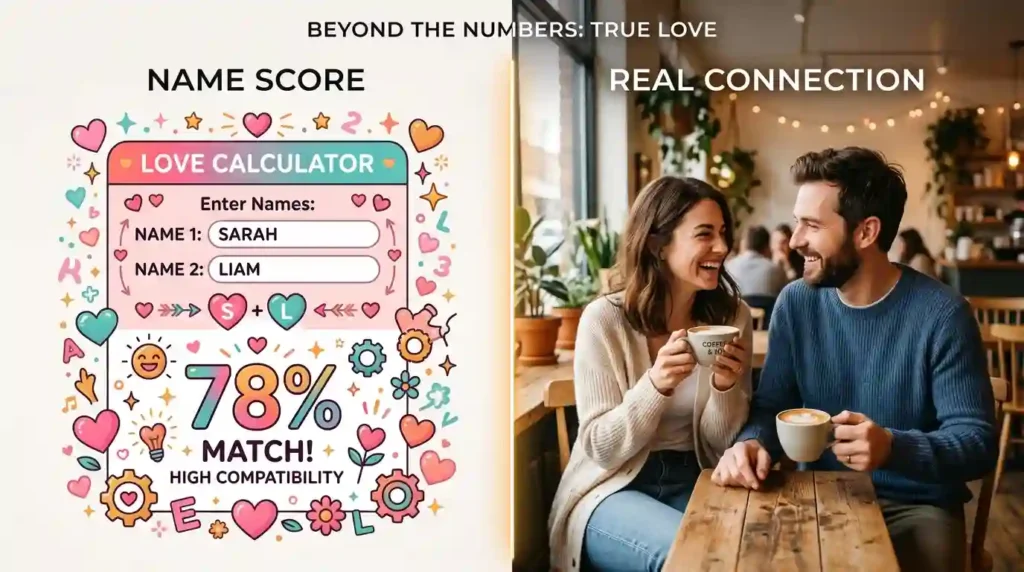
This is why a love score should be seen as entertainment, not relationship advice.
A name cannot tell whether someone will support you during hard times. It cannot tell whether they will listen to your feelings, respect your boundaries, or grow with you. Those things are revealed through real-life behavior.
So, while a name compatibility score can be fun, real compatibility is proven through actions.
Name Compatibility vs Real Relationship Compatibility
Name compatibility and real relationship compatibility are not the same thing.
Name compatibility is based on letters, sounds, initials, or symbolic calculations. Real compatibility is based on personality, emotions, habits, values, and behavior.
Here is a simple comparison:
| Factor | Name Compatibility | Real Relationship Compatibility |
| Based On | Names, letters, initials, formulas | Communication, values, trust, behavior |
| Purpose | Fun and entertainment | Understanding relationship potential |
| Accuracy | Depends on calculator formula | Depends on real-life interaction |
| Emotional Value | Playful and exciting | Deep and meaningful |
| Decision Power | Should not decide relationships | Can guide serious choices |
| Best Use | Conversation starter | Relationship growth and reflection |
A name compatibility test can give you a fun result. But real compatibility requires time, honesty, and emotional awareness.
For example, two people may have names that score 98% in a calculator. But if one wants marriage and the other does not, they may face serious compatibility issues. On the other hand, two people may get a 55% score but still share strong values, emotional trust, and a healthy bond.
That is why it is better to enjoy the love score without giving it too much power.
How Love Calculators Use Names to Create a Score
Every love calculator can use a different method. There is no single universal formula used by all tools. Some tools are simple, while others are more advanced or creative.
A name-based love calculator may use one or more of these methods:
Letter-Based Formula
The calculator checks the letters in both names and creates a score from the match. It may count repeated letters, shared letters, or letter positions.
Numerology-Inspired Formula
Some calculators assign numbers to letters and then reduce them to a final value. This gives the score a symbolic feeling.
Randomized Entertainment Formula
Some tools may use a mostly random or semi-random system to generate a result. The names may influence the result slightly, but the main purpose is entertainment.
Weighted Algorithm
A more advanced tool may use multiple factors, such as name length, letters, vowels, initials, and possible birthday data if included.
Custom Website Formula
Many websites create their own formula. This means the same two names may get different scores on different love calculators.
For example, one tool may give Sarah and John 82%, while another may give the same names 67%. This does not mean one is “right” and the other is “wrong.” It simply means both tools use different scoring systems.
If you want to try a fun love score yourself, you can use this tool: Check Your Love Compatibility Score.
And if you want to understand the logic behind name-based matching in more detail, read this guide: How Name Compatibility Tests Actually Work in Love Calculators.
What a High Love Compatibility Score May Suggest
A high love compatibility score can be exciting. It may suggest that the names match well according to the calculator’s formula. It can also make users feel more confident, hopeful, or entertained.
But a high score should be understood correctly.
A high score may mean:
- The names share similar letters
- The name lengths work well in the formula
- The initials match nicely
- The algorithm produced a strong result
- The tool found a symbolic connection
- The result is designed to feel positive and fun
It does not automatically mean:
- You are soulmates
- The relationship will last forever
- You will never have problems
- The other person feels the same way
- You are emotionally compatible
- You should make a serious decision based only on the score
A high score is best enjoyed as a fun sign, not a final answer.
If you get a strong score with someone you like, use it as a lighthearted conversation starter. You could say, “Our love score came out really high, should we trust it?” This can create a fun moment without adding pressure.
For couples, a high score can be playful. It can be used for social media posts, anniversary games, Valentine’s Day fun, or casual relationship quizzes.
The key is to enjoy the result without making it bigger than it is.
What a Low Love Compatibility Score Really Means
A low love compatibility score does not mean your relationship is doomed. It only means the calculator produced a lower result based on its formula.
Many people worry when they see a low score. They may wonder if it is a bad sign. But remember, the calculator does not know your real bond. It does not know how much you care, how well you communicate, or how strong your connection is.
A low score may happen because:
- The names do not share many letters
- The name lengths are very different
- The initials do not match in the formula
- The algorithm generated a lower result
- The spelling variation changed the score
- The tool uses a strict calculation method
It does not mean:
- You should break up
- You are not meant to be
- The other person is wrong for you
- Your relationship has no future
- Your feelings are fake
If you get a low score, treat it as entertainment. You can even test different versions of the names, such as nicknames or full names, to see how the result changes.
For example:
- Chris + Emily
- Christopher + Emily
- Chris + Em
- Christopher James + Emily Rose
Each version may produce a different score because the input changes.
That shows why the result should not be taken too seriously.
Should You Trust a Name Compatibility Test?
You can trust a name compatibility test as a fun tool, but not as a serious relationship guide.
A love calculator can be enjoyable when used with the right mindset. It can help people laugh, start conversations, explore romantic curiosity, or share something playful with a partner. But it should not replace real emotional judgment.
You should not use a love calculator to decide whether to start, continue, or end a relationship. Important relationship decisions should be based on real experiences, not only a digital percentage.
A healthy way to think about it is this:
A name compatibility score can tell you how your names match inside a calculator. It cannot tell you how your hearts, values, habits, and futures match in real life.
The best approach is balance. Enjoy the score, but pay more attention to how the person treats you.
Ask yourself:
- Do they respect me?
- Do I feel safe with them?
- Can we communicate openly?
- Do we share similar values?
- Do we support each other?
- Can we handle disagreements maturely?
- Do I feel emotionally comfortable around them?
These questions matter more than a percentage.
How to Use Love Compatibility Scores in a Healthy Way
Love compatibility scores can be fun when used correctly. The problem begins when people treat them as absolute truth.
Here are healthy ways to use a name-based love calculator.
Use It for Entertainment
The best use of a love calculator is fun. Try it with your crush, partner, celebrity crush, fictional couple, or friends. Enjoy the surprise without overthinking it.
Use It as a Conversation Starter
A love score can help start a light romantic conversation. It can make people laugh and open the door to playful flirting.
For example:
“Our names got 88%. I guess the calculator approves.”
This keeps the mood fun and relaxed.
Do Not Use It to Judge Someone
Never judge a person only because a calculator gave a low score. A name score does not measure kindness, loyalty, maturity, or emotional depth.
Compare It With Real Compatibility
After checking the score, think about real compatibility. Do you both communicate well? Do you share similar goals? Do you respect each other’s boundaries?
This gives the result a healthier context.
Avoid Obsessing Over the Number
It is easy to keep checking different name versions until you get a high score. That can be fun once or twice, but do not let the number control your emotions.
Remember That Love Requires Effort
Even the most compatible couples need effort. A high score does not remove the need for patience, care, honesty, and growth.

Why People Keep Searching for Name Compatibility Scores
Name compatibility searches are popular because they are simple, emotional, and instantly satisfying. People do not need expert knowledge to use them. They only need two names and a little curiosity.
There are several reasons people enjoy these tests.
They Are Quick
A name compatibility test gives an instant result. In a few seconds, the user gets a love percentage.
They Feel Personal
Because the tool uses real names, the result feels customized. Even if the formula is simple, the experience feels personal.
They Are Shareable
People love sharing love calculator results with friends, partners, or social media followers. A funny or high score can become part of a conversation.
They Add Fun to Romance
Romance already includes curiosity, excitement, and uncertainty. A love calculator adds a playful layer to those feelings.
They Create Hope
When someone has a crush, a high score can feel encouraging. It may not prove anything, but it can make the person feel happy for a moment.
They Are Nostalgic
Many people remember using love calculators during school, teenage years, or early internet days. That nostalgic feeling keeps these tools popular.
Can Changing Name Spelling Change the Love Score?
Yes, changing name spelling can change the love compatibility score in many calculators. Since the tool reads the entered text, even a small spelling difference can affect the result.
For example:
- Sofia vs Sophia
- Jon vs John
- Sara vs Sarah
- Lilly vs Lily
- Mohammed vs Muhammad
Each spelling has a different letter structure. If the calculator uses letters, vowels, consonants, or alphabet numbers, the final score may change.
This is why users sometimes test multiple name versions.
But again, this does not mean one spelling is more “romantically correct” than another. It only means the tool calculated a different result from different data.
If your score changes after spelling your name differently, that is normal. It shows how name-based algorithms work.
Do Nicknames Affect Love Compatibility Scores?
Yes, nicknames can affect the result because they usually contain fewer letters or different letters than full names.
For example:
- Samantha may score differently than Sam
- Benjamin may score differently than Ben
- Isabella may score differently than Bella
- Robert may score differently than Rob
Nicknames may feel more emotionally accurate because they are often used by close friends, partners, or family members. However, from a calculator’s perspective, a nickname is simply a different input.
If you want a fun comparison, try both versions:
- Your full name + their full name
- Your nickname + their nickname
- Your full name + their nickname
- Your nickname + their full name
This can make the experience more entertaining.
Are Love Compatibility Scores Based on Science?
Most name-based love compatibility scores are not based on relationship science. They are usually based on entertainment formulas, symbolic calculations, numerology-inspired methods, or custom algorithms.
Relationship science focuses on real human behavior. It studies communication, attachment, trust, conflict, emotional support, attraction, commitment, and social connection. A name-only calculator cannot measure these deeply.
That does not make love calculators useless. It simply means their purpose is different.
A love calculator is for fun. Relationship science is for understanding real human connection.
So, if you use a name compatibility score, enjoy it as a playful result. But if you want to understand your relationship seriously, look at how both people communicate, handle stress, respect boundaries, and support each other.
What Actually Makes Two People Compatible?
Real compatibility is not hidden inside a name. It is built through how two people connect, communicate, and grow together.
Here are the main factors that shape real love compatibility.
Emotional Compatibility
Emotional compatibility means both people understand and respect each other’s feelings. They may not feel everything the same way, but they try to listen and respond with care.
Communication Compatibility
Good communication means being able to talk honestly without fear. Compatible couples can discuss problems, needs, and expectations without turning every disagreement into a fight.
Value Compatibility
Shared values are important. If two people have completely different views about family, money, lifestyle, marriage, honesty, or future goals, the relationship may face challenges.
Lifestyle Compatibility
Lifestyle matters too. Sleep routines, social habits, career goals, spending habits, and daily routines can affect relationship comfort.
Conflict Compatibility
Every couple disagrees sometimes. The real question is how they handle conflict. Do they insult each other, avoid the issue, or solve problems respectfully?
Commitment Compatibility
Both people need to understand what they want. If one person wants a serious future and the other wants something casual, emotional confusion can happen.
Growth Compatibility
People change over time. A strong relationship allows both partners to grow without losing respect for each other.
These factors matter far more than a name-based score.
How to Read Your Love Compatibility Score Correctly
When you get a love compatibility score, do not ask, “Is this 100% true?” Instead, ask, “What can I take from this in a fun and positive way?”
Here is a simple way to read the score:
| Score Range | Fun Interpretation |
| 90%–100% | Very strong fun match according to the calculator |
| 75%–89% | Good playful compatibility result |
| 50%–74% | Average score, still fun to explore |
| 25%–49% | Low calculator match, not a real-life warning |
| 0%–24% | Very low score, but only for entertainment |
This table is not a scientific ranking. It is only a simple way to understand the result without stress.
If you get a high score, enjoy it. If you get a low score, laugh it off. Your relationship is not decided by a number.
Final Thoughts Before You Trust the Score
A love compatibility score can be exciting, especially when you are curious about someone. It gives you a quick answer, a little emotional thrill, and maybe even a reason to smile.
But love is more than letters.
Your name may influence the score inside a calculator, but your choices influence your relationship in real life. A strong bond is created through respect, honesty, patience, emotional support, and shared effort.
So, use name compatibility tests for fun. Share them with friends. Try different names. Laugh at surprising results. Enjoy the romantic curiosity.
But when it comes to real love, pay attention to actions, not just algorithms.
Conclusion
So, does your name influence your love compatibility score? Yes, it can influence the score when the calculator uses names as part of its formula. Names may affect the result through letters, initials, vowels, consonants, spelling, length, or numerology-style calculations.
However, your name does not decide your real relationship future. A love calculator score is a fun digital result, not a scientific prediction. It can entertain you, start a conversation, and add playfulness to romance, but it should never replace real emotional understanding.
True compatibility comes from communication, trust, shared values, respect, kindness, and consistent effort. A high name score may feel exciting, and a low score may feel surprising, but neither one should control your relationship decisions.
Enjoy the score, but trust real actions more.
FAQs
1. Does your name really affect your love compatibility score?
Yes, your name can affect the score in a name-based love calculator because the tool uses your name as input. It may calculate the result using letters, initials, name length, vowels, consonants, or a custom formula. But this does not mean your name controls your real relationship future.
2. Is a name compatibility score accurate?
A name compatibility score can be fun, but it is not scientifically accurate as a serious relationship prediction. It only shows a result based on the calculator’s formula. Real compatibility depends on communication, trust, values, respect, and emotional connection.
3. Why does my love score change when I change the spelling?
Your score may change because the calculator reads each spelling differently. For example, “Sara” and “Sarah” contain different letters, so the formula may produce a different result. This is common in name-based compatibility tools.
4. Should I worry if my love compatibility score is low?
No, you should not worry. A low love compatibility score does not mean your relationship will fail. It only means the calculator generated a lower result from the names entered. Real relationships are based on behavior, not just name matching.
5. Can nicknames change the love compatibility result?
Yes, nicknames can change the result because they usually have different letters and length compared to full names. For example, “Elizabeth” and “Liz” may produce different love scores.
6. Do love calculators use real science?
Most name-based love calculators are designed for entertainment, not scientific relationship analysis. Some may use symbolic formulas, alphabet values, or numerology-style methods, but they cannot measure real emotional compatibility.
7. What matters more than a name compatibility score?
Communication, respect, honesty, trust, shared values, emotional maturity, and conflict resolution matter more than a name compatibility score. These factors shape real relationship success.
8. Can two people with a low love score still be a good couple?
Yes, absolutely. A low calculator score does not define real compatibility. Two people can have a low name-based score and still build a strong, happy, and healthy relationship.
9. Why do people enjoy checking love compatibility scores?
People enjoy love compatibility scores because they are quick, fun, personal, and exciting. They create curiosity and can be used as a playful conversation starter with a crush or partner.
10. How should I use a love calculator result?
Use it for entertainment. Enjoy the result, share it, laugh about it, and have fun. But do not use it as the only basis for serious relationship decisions.