

Summary
If you are wondering what is the age difference between you and your partner, subtract the younger person’s birth date from the older person’s birth date. The result is the age gap, usually expressed in years, months, and days. That number can be useful, but it cannot determine compatibility on its own. Life stage, emotional maturity, shared values, communication, financial expectations, family planning, health, and long-term goals usually matter far more than a numerical difference.
Table of Contents
- What Is the Age Difference in a Relationship?
- How to Calculate an Exact Age Gap
- What Is the Age Difference That Works Best?
- What an Age Gap Can Mean for a Couple
- Potential Benefits of an Age-Gap Relationship
- Common Challenges and Warning Signs
- How to Build a Healthy Age-Gap Relationship
- Conclusion
- Frequently Asked Questions
What Is the Age Difference in a Relationship?
Age difference is the amount of time separating the births of two people. It is also called an age gap, age disparity, or calendar difference. If one romantic partner was born on May 10, 1990, and the other was born on August 25, 1995, their exact age difference is five years, three months, and fifteen days.
A simple age comparison may identify one person as the older person and the other as the younger person. It does not, however, describe the quality of their relationship. Two adults with a ten-year age gap may have compatible lifestyles and expectations, while two people born only months apart may want completely different futures.
People calculate age differences for many reasons. A dating couple may be curious about its age gap, while a married couple may want to record a relationship milestone. A parent might compare the ages of siblings or twins, and someone researching a family tree may compare one generation with another. Age calculations can also support age eligibility checks, although an online tool is not legal proof of age.
For playful relationship insights beyond age alone, readers can explore the Love Calculator. Such tools are best treated as entertainment and conversation starters rather than scientific predictions about love or relationship satisfaction.
How to Calculate an Exact Age Gap
You can calculate an age gap from two ages, two birth years, or two complete dates of birth. The right method depends on how much precision you need.
Method 1: Subtract the Two Ages
When only the current ages are known, use this formula:
Age difference = absolute value of age 1 − age 2
For example:
|42 − 35| = 7 years
The vertical lines indicate an absolute value, which turns a negative answer into a positive one. Because the purpose is to measure the distance between two ages, the order of subtraction does not matter.
This method is fast, but it may not provide the exact age gap. One person may have celebrated a birthday recently while the other person’s next birthday is still several months away.
Method 2: Subtract the Birth Years
If one person was born in 1988 and the other in 1996, the initial calculation is:
1996 − 1988 = 8 years
This gives an approximate time difference. It can be inaccurate by almost one year because it ignores the month and day of each birth.
Method 3: Compare Complete Birth Dates
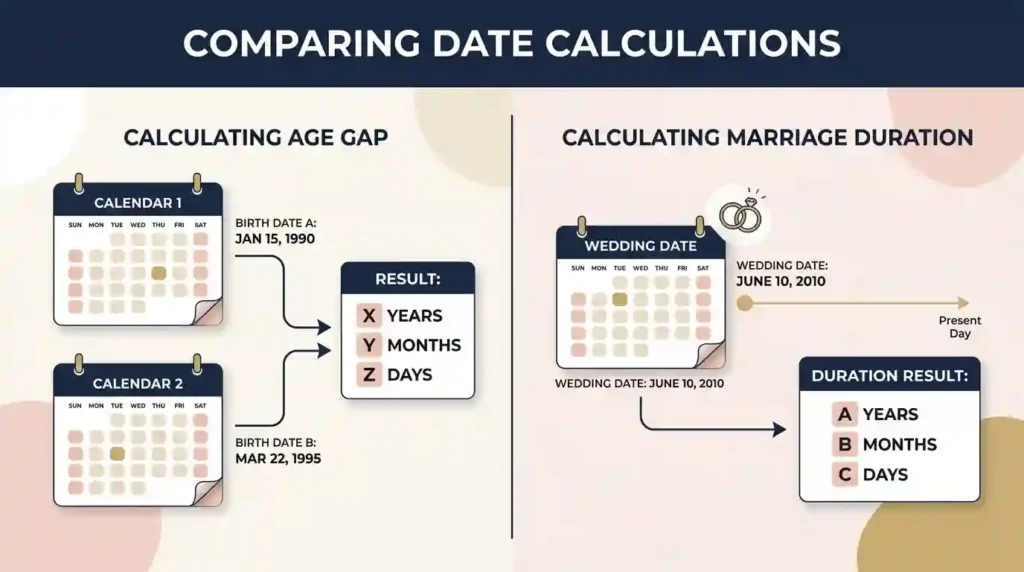
For an exact age, compare the full birth date of each person. Begin with the earlier birth date and count forward to the later birth date. The result can be displayed in years, months, and days.
Suppose one person was born on March 18, 1987, and the other on November 2, 1992. A calendar-based calculation gives an age gap of five years, seven months, and fifteen days.
Manual subtraction becomes more difficult when the later date has a smaller day or month number. You may need borrowing logic, similar to ordinary subtraction:
- Borrow days from the preceding month when the ending day is smaller than the starting day.
- Borrow one year, or 12 months, when the ending month is smaller than the starting month.
- Adjust for each month’s actual length.
This process is sometimes called a date crossover. It must account for varying month lengths—28, 29, 30, or 31 days—as well as every leap year.

Leap Years and Leap-Day Births
A leap-day birth on February 29 requires special attention. In a non-leap year, some systems use February 28 for age calculations, while others recognize March 1 for a particular legal or administrative purpose. The correct convention may depend on local law or the institution requesting age verification.
For a romantic age comparison, this technical difference rarely matters. For an official age form, school deadline, employment requirement, benefit, or other critical decision, confirm the rule with an authoritative source.
Using an Age Difference Calculator
An online age difference calculator or age gap calculator handles calendar logic automatically. Enter both dates of birth, select an as-of date if the tool provides that option, and review the result.
A detailed calculator may show:
- The chronological age of each person
- The exact difference in years, months, and days
- The total days between the two births
- Which person is older or younger
- The difference in weeks, hours, minutes, or seconds
The age gap between two people never changes. Their individual ages change over time, but the interval separating their births remains constant. An as-of date is useful when you want to know each person’s exact age on a wedding date, anniversary, historical date, or another milestone.
Readers tracking long-term milestones may also enjoy the guide on how long have i been married, which complements an age calculation by focusing on the duration of the marriage itself.
What Is the Age Difference That Works Best?
There is no universally ideal age difference for a relationship. A small age gap does not guarantee happiness, and a large age disparity does not automatically cause a relationship to fail.
An average age gap can describe a population, but it cannot prescribe what is right for an individual couple. The U.S. Census Bureau’s families and living arrangements data provides demographic information about married couples, unmarried partners, families, and households in the United States. These statistics are useful for understanding social patterns, not for rating the strength of a specific relationship.
Age-gap discussions often focus on heterosexual partnerships in which the man is older, but age differences occur in every kind of relationship. An older woman may date a younger man, and same-sex couples may also have small or substantial gaps. Compatibility cannot be inferred from the genders of the partners or from which person was born first.
The Half-Your-Age-Plus-Seven Rule
The half-your-age-plus-seven rule, sometimes shortened to the rule of seven, is a popular guideline for estimating a socially acceptable minimum dating age.
Under the rule, a 40-year-old’s suggested minimum dating age would be:
40 ÷ 2 + 7 = 27
A related formula estimates a maximum dating age:
(Your age − 7) × 2
For a 40-year-old, that calculation produces a maximum of 66.
These formulas are social conventions, not scientific laws. They do not measure emotional maturity, consent, power balance, relationship satisfaction, or long-term compatibility. They should never replace legal age requirements, personal judgment, or an honest assessment of the relationship.
Age Is One Variable, Not the Verdict
When someone asks, “What’s the age difference, and is it too much?” the more useful question is whether both partners have equal freedom, respect, and influence.
A seven-year difference between people aged 19 and 26 may create more significant life-stage concerns than the same difference between people aged 39 and 46. Chronological age matters, but context matters too.
What an Age Gap Can Mean for a Couple
A noticeable generational difference may affect a relationship in practical and emotional ways. Some effects are positive, some are challenging, and many depend on the individuals involved.
Life Stage and Long-Term Plans
Partners at different life stages may have different immediate priorities. The younger person may be building a career, completing an education, traveling, or establishing financial independence. The older person may be focused on home ownership, retirement planning, health, or caring for aging family members.
These differences become important when they affect a shared goal. Couples should discuss:
- Marriage and commitment
- Family planning and fertility
- Children from previous relationships
- Career moves and relocation
- Spending, saving, and financial stability
- Retirement timing
- Future health and caregiving
- Preferred lifestyle and social activities
No single answer is correct. The goal is to discover whether the partners’ long-term aspirations can support one another.
Emotional Maturity and Life Experience
Age and emotional maturity are related only imperfectly. An older partner may have more life experience, but that does not automatically make that person a better communicator or decision-maker. A younger partner may bring adaptability, energy, technological confidence, or a fresh perspective.
A healthy couple respects both sets of contributions. Experience should be shared, not used to control. Differences in knowledge, income, or status should never erase the younger partner’s voice.
Cultural Background and Generational Experience
People from different generations may have distinct memories, cultural references, technology habits, communication styles, or social values. These differences can be enjoyable when both partners remain curious. They can also create friction when one partner dismisses the other as too young, too old, outdated, or immature.
Cultural background matters as well. Families and communities hold different beliefs about an acceptable age gap, marriage, gender roles, and family responsibility. Couples may therefore experience varying levels of social acceptance.

Attraction and Partner Preference
Attraction is personal and complex. Evolutionary psychology sometimes connects partner preference with fertility, resources, youth, protection, or reproductive success. Social learning, personality, life history, and individual values also influence attraction.
These theories describe broad tendencies; they do not explain every romantic partner or justify unequal treatment. A person may value humor, kindness, emotional intelligence, stability, adventure, confidence, or shared interests more than age.
Tools such as the True Love Calculator can add a lighthearted element to the conversation, but genuine attraction and emotional connection are demonstrated through consistent behavior.
Potential Benefits of an Age-Gap Relationship
Age-gap relationships can offer the same love, security, intimacy, and companionship as relationships between similarly aged partners. They may also create distinct opportunities.
Broader Perspectives
Different generational experiences can expand both partners’ understanding of culture, work, family, technology, and personal growth. Each person can introduce the other to new ideas without acting as a teacher or authority figure.
Complementary Strengths
One partner may bring experience and stability, while the other brings flexibility and enthusiasm. The healthiest dynamic is reciprocal: both people give, learn, adapt, and retain their independence.
Intentional Communication
Because age-gap couples may anticipate questions about their differences, they sometimes discuss expectations more deliberately. Open communication about money, family planning, health, retirement, and social pressure can build trust.
Greater Clarity About Compatibility
A visible age disparity encourages couples to examine what truly connects them. Shared values, emotional safety, mutual respect, sexual satisfaction, honesty, and compatible goals are more meaningful than matching birth years.
For another playful way to start a compatibility conversation, couples can try the Soulmate Compatibility Calculator and then discuss where their real-life answers align or differ.
Common Challenges and Warning Signs
A large age difference is not inherently unhealthy. Certain behaviors, however, should be taken seriously in any relationship.
Power Imbalance
A power imbalance can emerge when one person controls money, housing, transportation, employment opportunities, healthcare, or access to friends and family. A difference in financial stability may make a younger or less-established partner particularly vulnerable.
Watch for behavior such as:
- Making every major decision unilaterally
- Using money to demand obedience
- Treating experience as unquestionable authority
- Isolating a partner from friends or family members
- Monitoring messages, movements, or spending
- Dismissing concerns as immaturity
- Pressuring a partner about sex, marriage, or pregnancy
The issue is not the age gap itself; it is control, coercion, or exploitation.
Societal Judgment and Stereotypes
Age-gap couples may encounter unwanted comments or labels. An older person may be portrayed as predatory, while a younger partner may be stereotyped as naïve or financially motivated. These assumptions ignore the actual people involved.
A united response can help, but neither partner should use outside criticism to silence legitimate concerns. Social judgment and thoughtful feedback are not always the same thing. Trusted friends may notice a troubling pattern that someone inside the relationship has normalized.
Different Energy, Health, and Retirement Timelines
A substantial gap can mean that one partner experiences health changes or retirement much earlier. The younger person may become a caregiver sooner than expected, creating emotional strain or burnout.
Couples should discuss future responsibilities before a crisis occurs. Honest planning may include health insurance, retirement income, housing, estate arrangements, family support, and the boundaries of caregiving.
Sexual and Emotional Needs
Sexual satisfaction can change with stress, health, hormones, medication, and aging. These changes are not unique to age-gap couples, but different timelines may make them more visible.
Empathy, honesty, medical guidance when appropriate, and respectful communication can help partners respond without shame. No one should feel pressured to ignore personal boundaries to “make up for” an age difference.
If a relationship ends, recovery is not determined by the former partners’ ages. The Breakup Recovery Time Calculator can provide a reflective starting point, while real healing depends on support, healthy routines, and time.
How to Build a Healthy Age-Gap Relationship
The strongest age-gap relationships are not built by ignoring the difference. They succeed by addressing relevant differences without allowing age to define the entire partnership.
Practice Open Communication
Discuss expectations before they become sources of resentment. Talk about commitment, finances, children, retirement, social life, caregiving, and what each person wants over the next five, ten, or twenty years.
Communication should be two-way. Listening matters as much as speaking.
Protect Equality and Independence
Both partners should have meaningful influence over decisions. Whenever possible, each person should maintain personal friendships, financial awareness, privacy, interests, and the ability to disagree safely.
Mutual respect is visible when neither partner uses age as a weapon. “You are too young to understand” and “you are too old to change” both shut down productive conversation.
Build Shared Values and Goals
Partners do not need identical backgrounds or interests. They do need enough alignment on foundational issues such as loyalty, family, money, lifestyle, intimacy, and conflict resolution.
A shared value creates direction. A shared goal turns that direction into practical action.
Use Flexibility and Compromise
Different generations may approach technology, celebrations, leisure, and communication differently. Adaptability allows both partners to create a shared culture instead of forcing one person to live entirely in the other’s world.
Compromise should remain balanced. If the younger person always changes plans or the older person always pays and decides, resentment may grow.
Ask for Professional Support When Needed
A qualified relationship expert or couples therapist can help partners examine recurring conflict, power dynamics, family pressure, sexual concerns, and future planning. Couples therapy is not only for relationships in crisis; it can also provide a structured space for preventive conversations.
Explore more tools and guides in Relationship Calculators & Milestones when you want to reflect on relationship timing, compatibility, and meaningful shared events.
Conclusion
Age difference is the calendar interval between two people’s births, most accurately calculated from their complete dates of birth. An age difference calculator can express that interval in years, months, days, total days, or even smaller units. It can tell you who is older and by exactly how much, but it cannot tell you whether a relationship will succeed.
The meaning of an age gap depends on context. Life stage, legal adulthood, power balance, emotional maturity, health, finances, family planning, communication, shared values, and long-term goals provide a much clearer picture than subtraction alone.
A healthy relationship allows both adults to make free decisions, maintain their identities, express concerns, and shape their future together. Whether the gap is one year or several decades, compatibility grows through honesty, empathy, respect, flexibility, and consistent care.
Frequently Asked Questions
What is the age difference between two people?
It is the amount of time between their birth dates, usually expressed in years, months, and days.
What’s the age difference formula?
Subtract one age from the other and use the absolute value: |age 1 − age 2|.
How do I calculate an exact age gap?
Compare both complete dates of birth and count the calendar difference from the earlier date to the later date.
Does the order of the birth dates matter?
No. An age gap calculator uses the absolute difference and identifies the older and younger person automatically.
Do leap years affect age-difference calculations?
Yes. Leap years and varying month lengths can affect the exact number of days between two birth dates.
Is a ten-year age gap too much?
Not necessarily. Consent, life-stage compatibility, equality, communication, and shared goals matter more than a fixed number.
What is the best age difference for marriage?
There is no universal best gap. Relationship quality depends more on mutual respect, compatible expectations, and emotional connection.
Is the half-your-age-plus-seven rule reliable?
It is a social rule of thumb, not a scientific or legal standard. Use judgment and consider the full relationship context.
Can age difference affect relationship satisfaction?
It can influence life-stage concerns and social pressure, but it does not determine satisfaction by itself.


